

Peru gave me far more than the Machu Picchu trip I'd originally imagined.
I found ancient Inca sites, colourful colonial cities, enormous Andean landscapes, desert scenery, deep canyons, and some of the best food I ate anywhere in South America. What struck me most was how different each part of the country felt from the last.
If you're planning your first trip, these are the 10 places in Peru I'd make room for on your itinerary.
Have You Seen Our Travel Concierge Service?
Your trip, planned by local experts
We are not a travel agent - we design custom itineraries around your budget and style, without receiving commissions or booking fees.
Custom itinerary
Built around your dates, budget, and travel style.
Local expert knowledge
Recommendations from people on the ground, not review sites.
Travel smarter, spend less
We optimise for your budget to make your money go further.
Nazca
(pronounced: NAS-ka)
Nazca at a glance
Southern Peru, around 450 km south of Lima
Nazca Lines, archaeology, desert landscapes, and scenic flights
1 night
History lovers, photographers, and curious travellers
Mysterious, arid, remote, otherworldly
Year-round, with morning flights usually preferable
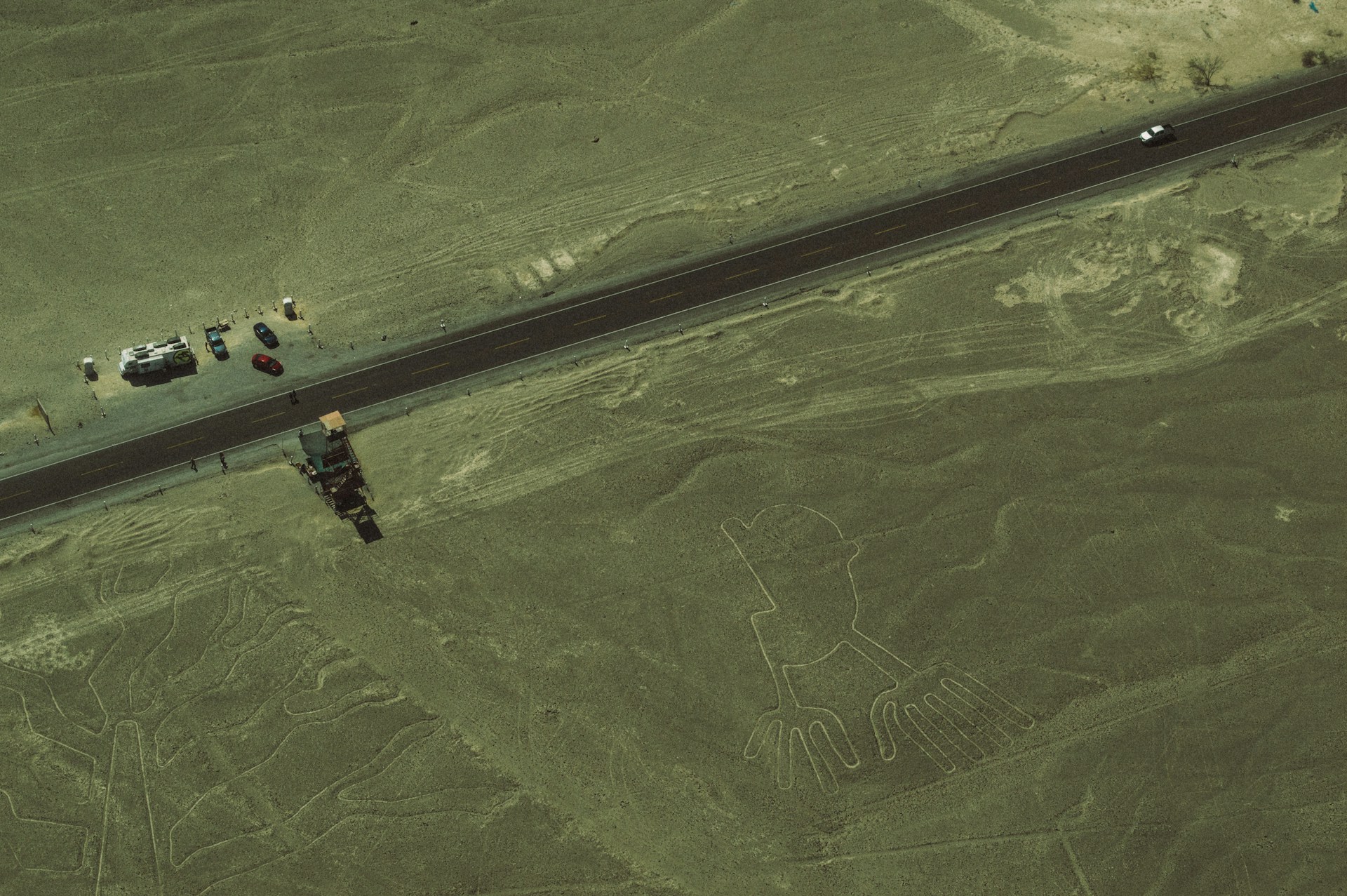
Nazca was one of the strangest places I visited in Peru, mostly because the experience I'd travelled there for only really made sense once I was in the air.
I took a small plane over the Nazca Lines, and I'll admit the flight itself was an adventure.
The plane banked sharply from side to side so everyone could see the geoglyphs below, and my stomach definitely noticed.
But then the hummingbird appeared against the desert floor, followed by figures such as the spider and monkey, and suddenly I understood why people make the journey here.
What fascinated me was how subtle the lines could look from above. They weren't enormous trenches or structures rising from the ground, but carefully created markings spread across a vast, almost completely barren landscape.
Knowing that many were created roughly 1,500 to 2,000 years ago only added to the mystery.
Researchers have proposed ceremonial, astronomical, and water-related explanations for the lines, but there's still debate around their exact purposes.
I actually liked leaving Nazca without a neat answer.
How Nazca fits into your Peru itinerary
Nazca fits naturally into an overland journey south from Lima, particularly if you're also visiting Paracas and Huacachina. I'd stay overnight rather than trying to squeeze the long journey and scenic flight into the same day.
Book the earliest flight you reasonably can. Morning conditions are often calmer, which matters when you're flying in a tiny aircraft that repeatedly banks over the desert.
Huaraz and the Cordillera Blanca
(pronounced: wa-RAS / kor-dee-YEH-ra BLAN-ka)
Huaraz and the Cordillera Blanca at a glance
Ancash Region, northern Peruvian Andes
Hiking, alpine lakes, glaciers, and high-altitude scenery
4-5 nights
Hikers, trekkers, photographers, and mountain lovers
Rugged, adventurous, high-altitude, spectacular
May to September
Huaraz was all about the mountains for me. The city itself was useful as a base, but every morning I found myself looking beyond it towards the enormous snow-covered peaks of the Cordillera Blanca.
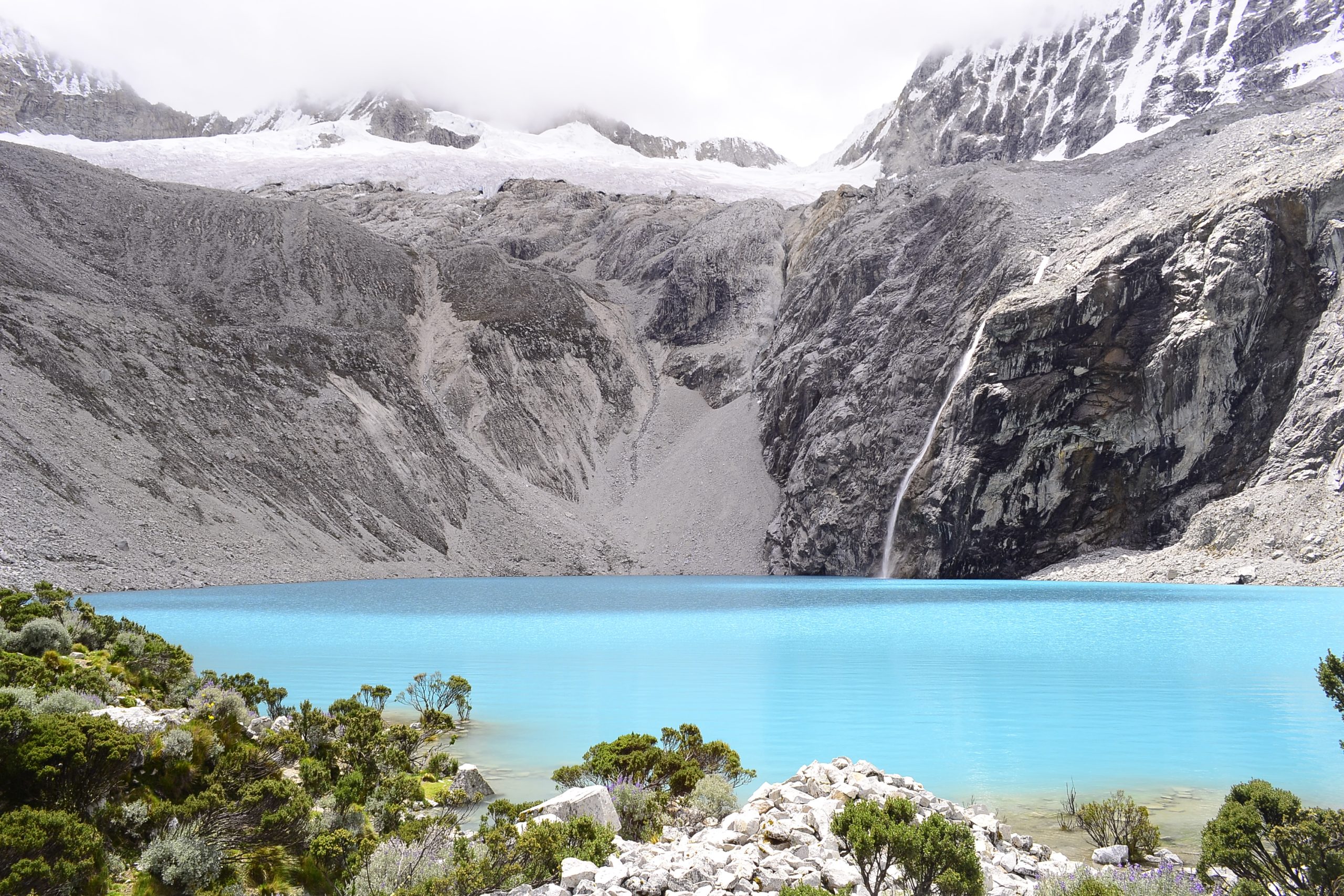
My standout day was hiking to Laguna 69. The trail climbed through a wide valley past waterfalls and grazing cattle before becoming noticeably steeper as I gained altitude.
By that point, every uphill section felt harder than it normally would, and the final climb was a proper test.
Then I reached the lake.
Laguna 69 was an almost impossibly bright turquoise, sitting beneath glaciers and sheer mountain walls at around 4,600 metres.
I spent longer there than I'd planned, partly because the scenery was incredible and partly because I was very happy to stop walking uphill.
There are much bigger adventures around Huaraz too, including the multi-day Santa Cruz trek through the Cordillera Blanca.
What I loved most was that this part of Peru felt entirely focused on being outdoors. If hiking is one of the reasons you travel, I'd make room for Huaraz.
How Huaraz fits into your Peru itinerary
Huaraz is a substantial detour north from Lima, so I'd treat it as a dedicated mountain stop rather than squeezing it into the classic southern Peru circuit. Allow at least four nights, and longer if you want to complete one of the region's multi-day treks.
Don't make Laguna 69 your first hike. Spend a couple of days acclimatising in Huaraz and start with an easier excursion before tackling a trail that climbs above 4,500 metres.
Chachapoyas and Kuélap
(pronounced: cha-cha-POH-yas / KWEH-lap)
Chachapoyas and Kuélap at a glance
Amazonas Region, northern Peru
Kuélap, waterfalls, archaeology, cloud-forest hiking
3-4 nights
History lovers, hikers, photographers, and adventure seekers
Misty, remote, historic, and adventurous
May to September
Chachapoyas showed me a side of Peru I hadn't really associated with the country before.
Instead of dry Andean mountains, I found misty green ridges, thick cloud forest, waterfalls, and archaeological sites hidden among the hills.
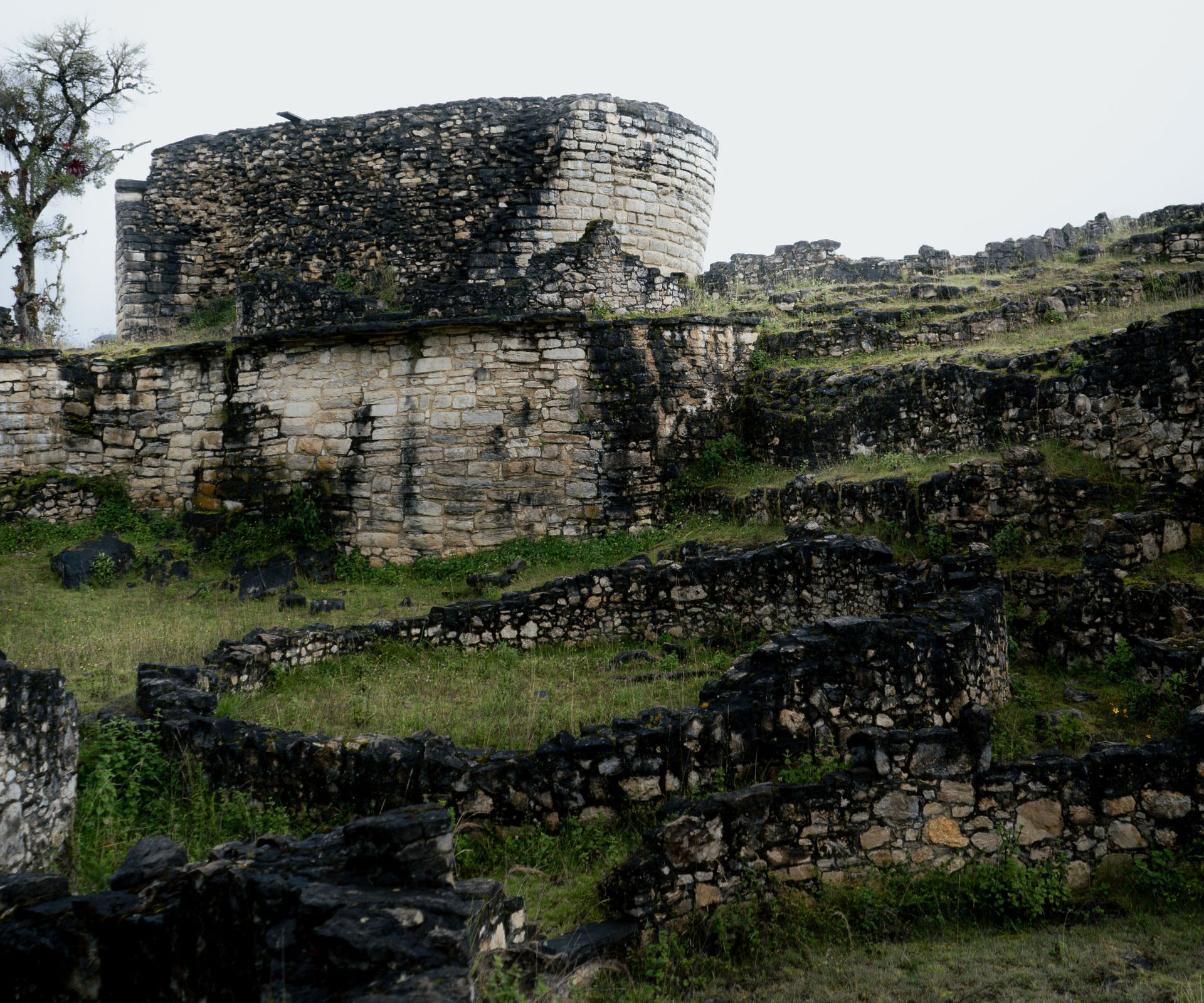
Kuélap was the place I most wanted to see. Built by the Chachapoya culture centuries before the Incas arrived, the enormous stone complex sits high on a mountain ridge.
I took the cable car up, and watching the landscape unfold beneath me was part of the experience. Once there, I explored the huge defensive walls and distinctive circular structures while clouds drifted across the surrounding mountains.
I also made time for Gocta Waterfall. The hike took me through lush forest and farmland before the falls eventually appeared across the valley, dropping dramatically down the mountainside.
It was a completely different experience from Kuélap and gave me another reason to stay several days rather than rushing through.
What I enjoyed most was combining archaeology with proper outdoor exploration. Around Chachapoyas, the journey through the landscape often felt as memorable as the sites themselves.
How Chachapoyas and Kuélap fit into your Peru itinerary
Chachapoyas requires a dedicated detour into northern Peru, so I'd allow at least three or four nights for Kuélap, Gocta, and the surrounding area.
It makes particular sense as part of a longer northern Peru itinerary rather than trying to add it to a short Lima–Cusco–Machu Picchu trip.
Check the latest access arrangements for Kuélap before you go. Conservation work and visitor restrictions have affected which parts of the archaeological complex can be entered at different times.
Lima
(pronounced: LEE-ma)
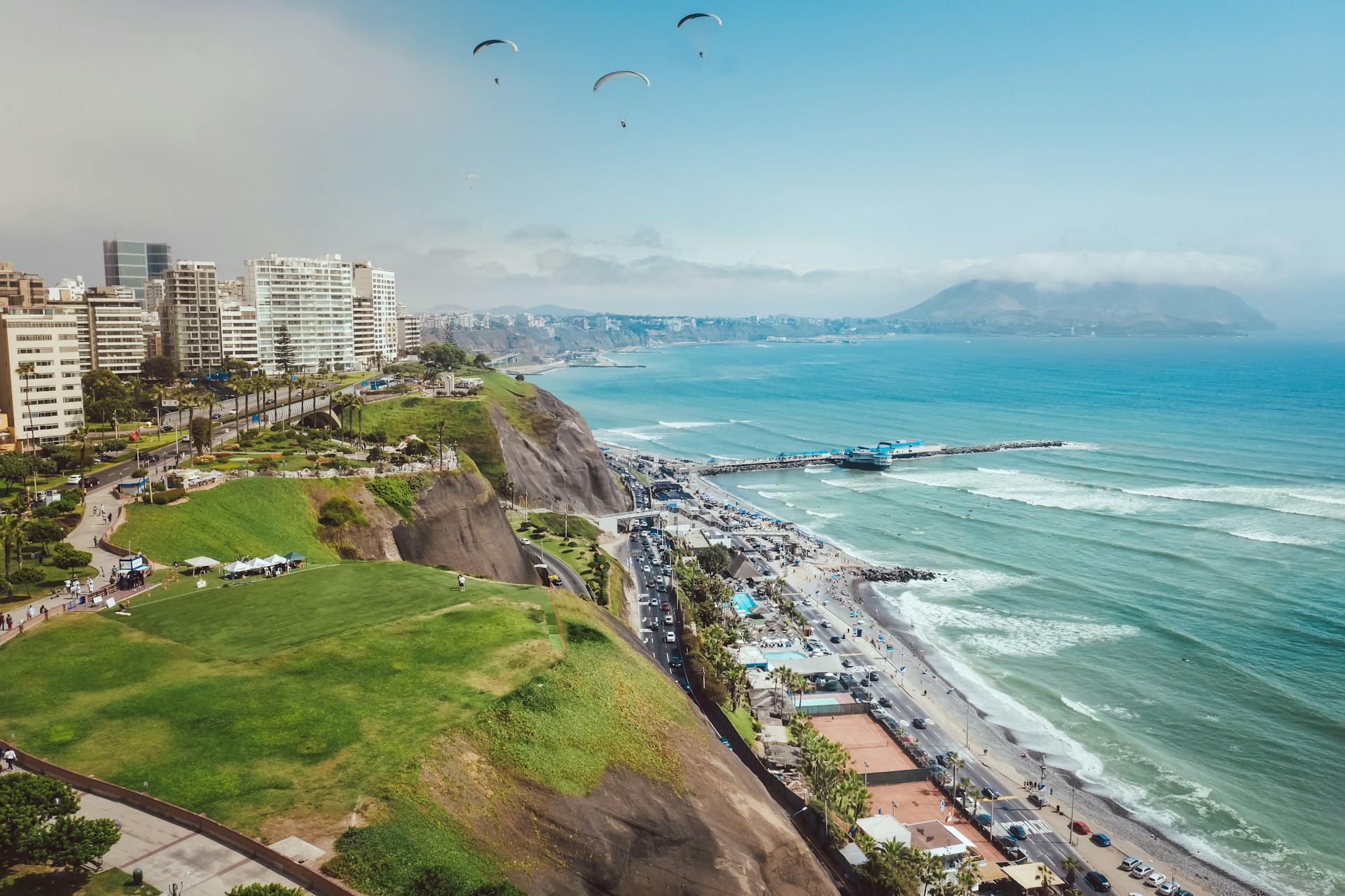
Lima at a glance
Central coast of Peru, overlooking the Pacific Ocean
Peruvian food, coastal views, nightlife, and culture
2-3 nights
Foodies, culture lovers, couples, and city-break travellers
Food-focused, coastal, energetic, and creative
December to April
I could happily have planned my entire time in Lima around food. Peru's capital has an extraordinary restaurant scene, but one of the meals I remember most was also one of the simplest: ceviche for lunch.
The fish arrived in chunky, tender pieces, swimming in sharp, citrusy leche de tigre with red onion, chilli and coriander. The first mouthful was intensely fresh and acidic, followed almost immediately by the heat of the chilli.
On the side, sweet potato softened that sharpness, while the large kernels of Peruvian corn added a completely different texture. It was bright, spicy, salty and refreshing all at once.
Paired with a cold pisco sour, it was the meal that made me understand why people talk about eating their way through Lima.
Thankfully, I did occasionally stop eating.
I walked the clifftops around Miraflores overlooking the Pacific and spent time in Barranco, where colourful street art, old mansions, cafés and bars gave the neighbourhood a more creative feel.
I'd originally thought of Lima as the gateway to Peru. I left thinking it deserved to be a destination in its own right.
How Lima fits into your Peru itinerary
Lima is the natural starting point for most Peru itineraries. I'd spend at least two nights here before heading south towards Paracas and Nazca, north towards Huaraz, or flying into the Andes for the next part of the trip.
Eat ceviche at lunchtime. Traditionally, Peruvians tend to eat it earlier in the day, and dedicated cevicherías may close by late afternoon.
Colca Canyon
(pronounced: KOL-ka)
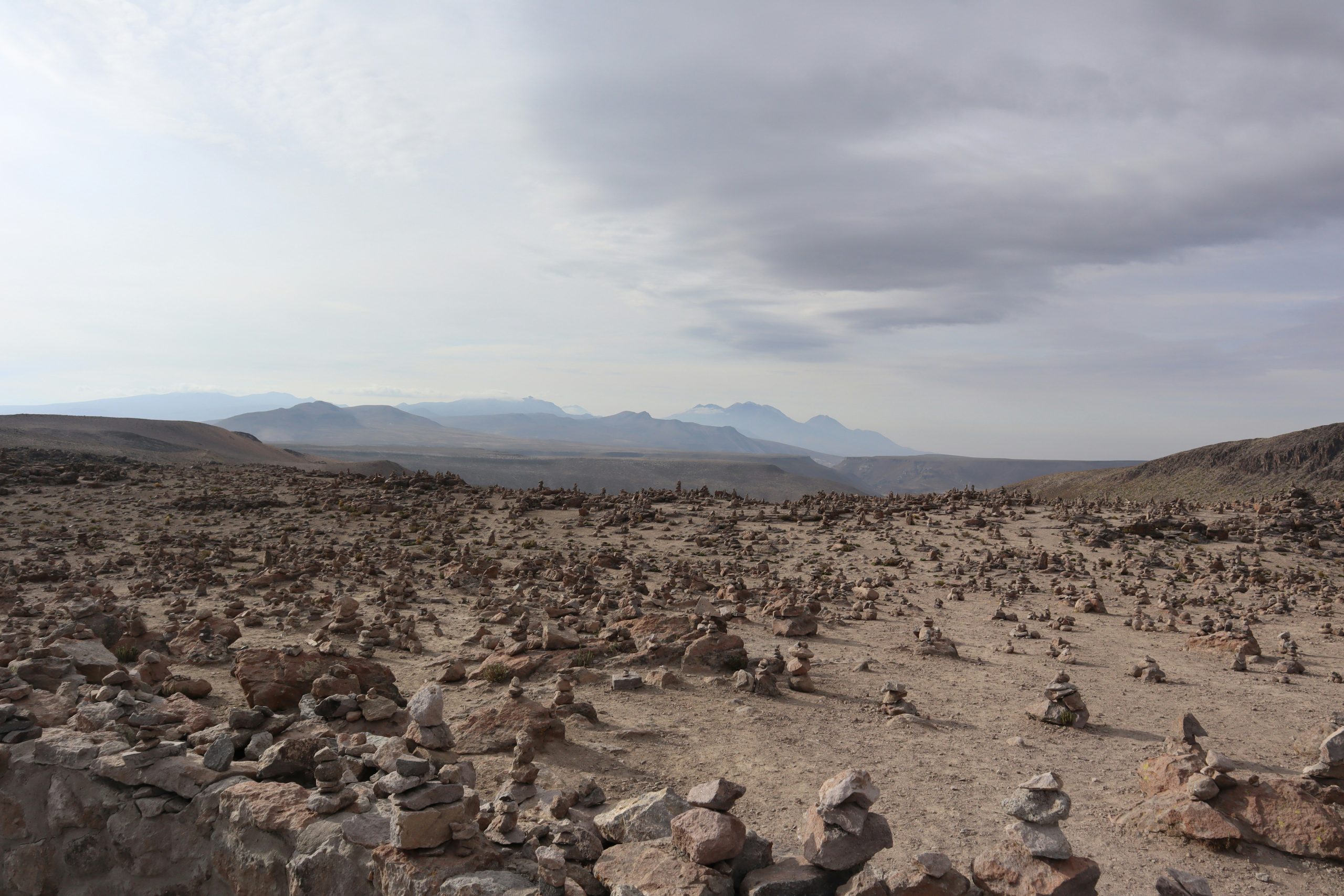
Colca Canyon at a glance
Southern Peru, northwest of Arequipa
Andean condors, canyon scenery, and hiking
2 nights
Wildlife lovers, photographers, and nature lovers
Dramatic, peaceful, traditional, and wild
May to September
I'd seen plenty of incredible landscapes by the time I reached Colca Canyon, but standing on the edge and watching an Andean condor rise out of the gorge below was something else entirely.
I went to the Cruz del Cóndor viewpoint early in the morning, when the birds use the warming air currents to gain height.
At first I was staring into what seemed like an empty canyon. Then a condor appeared below us, circling upwards almost effortlessly.
Eventually it swept past surprisingly close, and seeing its enormous wingspan against the canyon walls gave me a completely different sense of its size.
The condors were the highlight, but I loved the wider Colca Valley too. Ancient agricultural terraces covered the mountainsides, while small villages and white churches broke up the otherwise enormous landscape.
I also found that staying in the valley made the experience feel much less like a quick sightseeing excursion from Arequipa.
After a day of viewpoints, winding mountain roads and walking, soaking in one of the valley's natural hot springs was a pretty perfect way to finish.
How Colca Canyon fits into your Peru itinerary
I'd visit Colca Canyon after Arequipa and spend two nights in the valley. From there, you can return to Arequipa or continue towards Lake Titicaca, making it a natural part of an overland journey through southern Peru.
Bring layers to Cruz del Cóndor. It can be surprisingly cold while you're waiting early in the morning, even when the day becomes warm and sunny later.
The Peruvian Amazon
(pronounced: PWEHR-toh mal-doh-NA-doh)
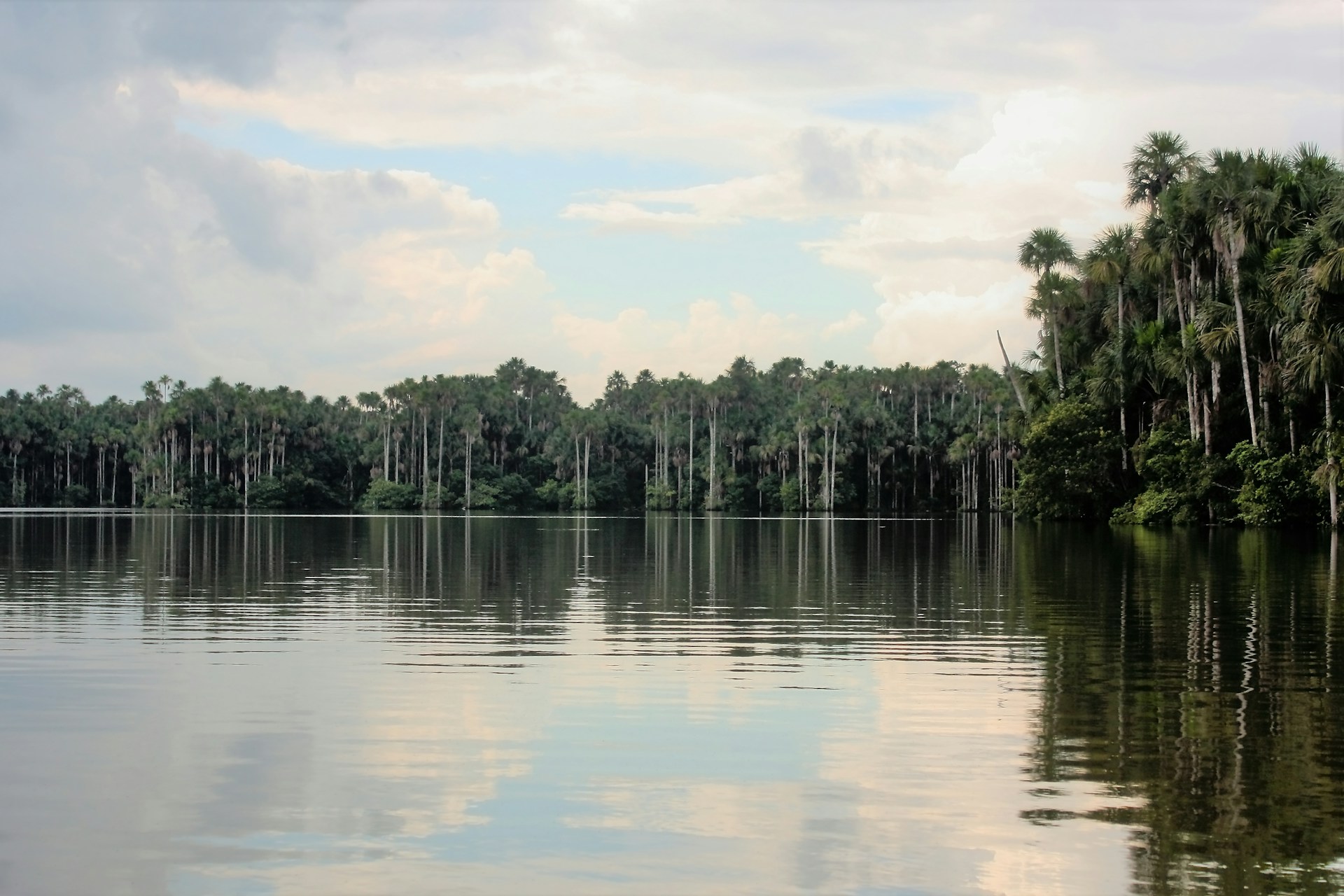
The Peruvian Amazon at a glance
Eastern Peru, with major gateways at Puerto Maldonado and Iquitos
Wildlife, rainforest, river trips, and jungle lodges
3-4 nights
Wildlife and nature lovers, and adventure travellers
Wild, humid, immersive, and remote
May to October for generally drier conditions
The Peruvian Amazon was one of those places where I quickly realised how little control I had over what I might see. I could go looking for wildlife, but the rainforest ultimately decided what showed up.
I based my experience around Puerto Maldonado, which was surprisingly easy to reach from Cusco. From there, travelling by boat into the jungle felt like crossing into another Peru entirely.
The mountains disappeared, the air became hot and heavy, and seemingly every patch of forest contained something moving or calling.
The wildlife was obviously the highlight. I watched brightly coloured macaws gather around a clay lick, spotted monkeys moving through the canopy, and went out after dark looking for the reflected eyes of caimans along the water.
I loved the early mornings most, when the river was still and the jungle seemed ridiculously loud with birds and insects.
Staying at a jungle lodge also made a huge difference. Instead of visiting the Amazon for a few hours, I woke up surrounded by it and experienced how dramatically the forest changed between dawn, daytime and night.
How the Peruvian Amazon fits into your Peru itinerary
Puerto Maldonado works particularly well after Cusco because you can fly between them and add three or four nights in the rainforest without a huge detour.
I'd choose Iquitos instead if the Amazon itself were a major focus of the trip and I wanted a deeper river-based experience.
Pack lightweight long trousers and long-sleeved shirts rather than relying entirely on insect repellent. They helped enormously with mosquitoes while still being comfortable in the heat.
Lake Titicaca
(pronounced: tee-tee-KA-ka)
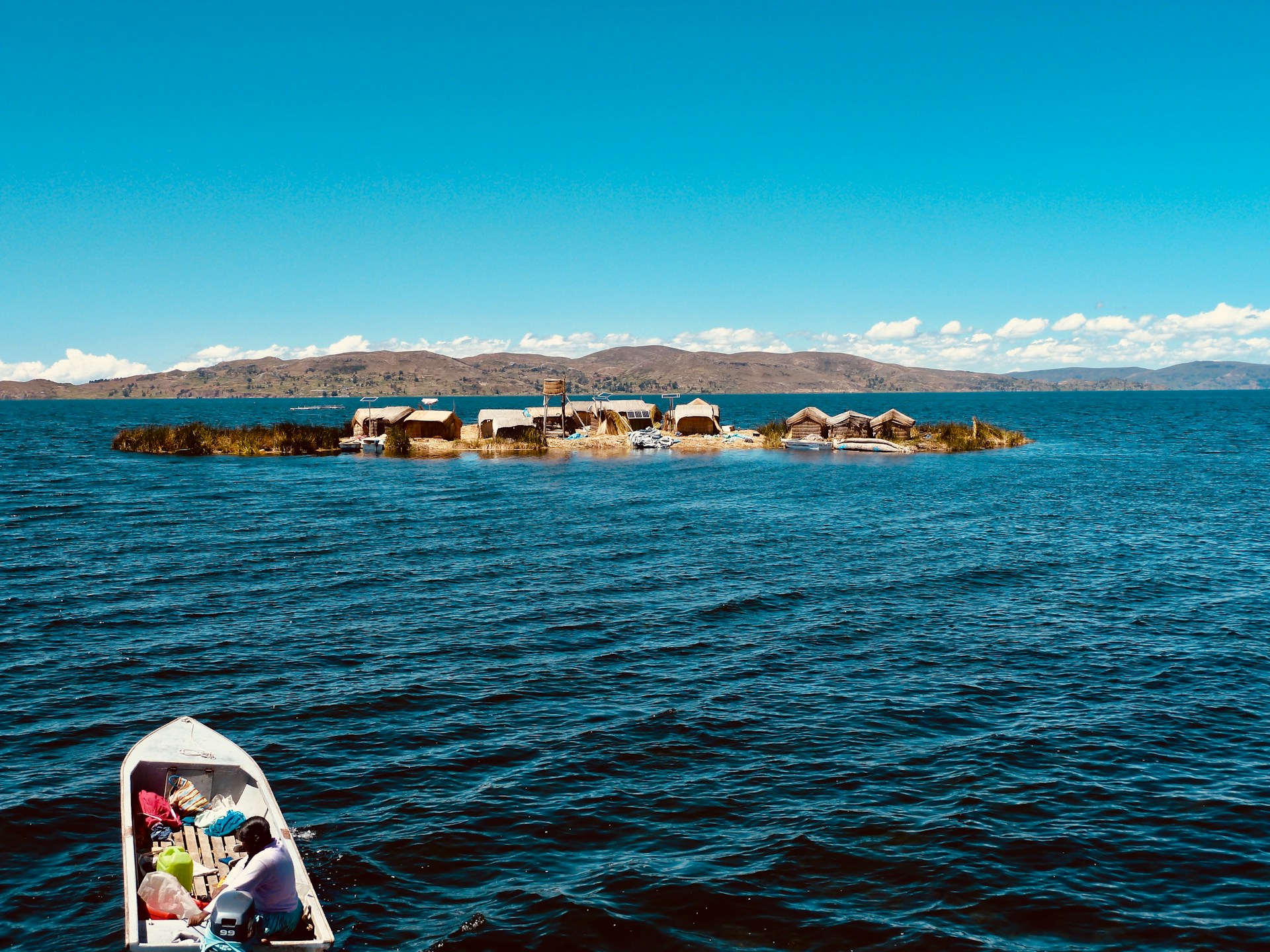
Lake Titicaca at a glance
Southern Peru, on the border with Bolivia
Island communities, traditional culture, and lake scenery
2 nights
Culture lovers, slow travellers, and families
Peaceful, traditional, high-altitude, and striking
May to September
Lake Titicaca was even more striking than I'd expected. At nearly 3,800 metres above sea level, the water was an incredibly deep blue, and on a clear day I could see mountains stretching across the horizon.
I travelled onto the lake from Puno and visited the floating Uros islands first.
Walking on them was an experience in itself. The layers of totora reeds felt soft and slightly springy beneath my feet, and seeing how the same reeds were used for homes, boats and handicrafts gave me a much better understanding of life on the lake.
I enjoyed getting farther away from Puno even more. Taquile felt quieter, with terraced hillsides, stone paths and wide views across the water.
I also found its textile traditions fascinating, particularly learning how weaving and knitting remain an important part of local culture.
Spending the night on an island was what turned Titicaca from a sightseeing stop into something much more personal for me.
Once the day-trippers had gone, the lake became incredibly peaceful, and watching the light disappear across the water was one of my favourite memories from southern Peru.
How Lake Titicaca fits into your Peru itinerary
I'd place Lake Titicaca between Arequipa and Cusco on a longer southern Peru route, ideally allowing two nights rather than rushing through Puno. It's also a natural crossing point if you're continuing into Bolivia.
Bring genuinely warm clothing if you're staying overnight. The strong daytime sun can make Titicaca feel deceptively mild, but temperatures drop quickly once it gets dark.
Arequipa
(pronounced: a-reh-KEE-pa)
Arequipa at a glance
Southern Peru, beneath the Andes
Colonial architecture, regional food, and volcano views
2-3 nights
Foodies, history lovers, and photographers
Elegant, sunny, historic, and relaxed
May to September
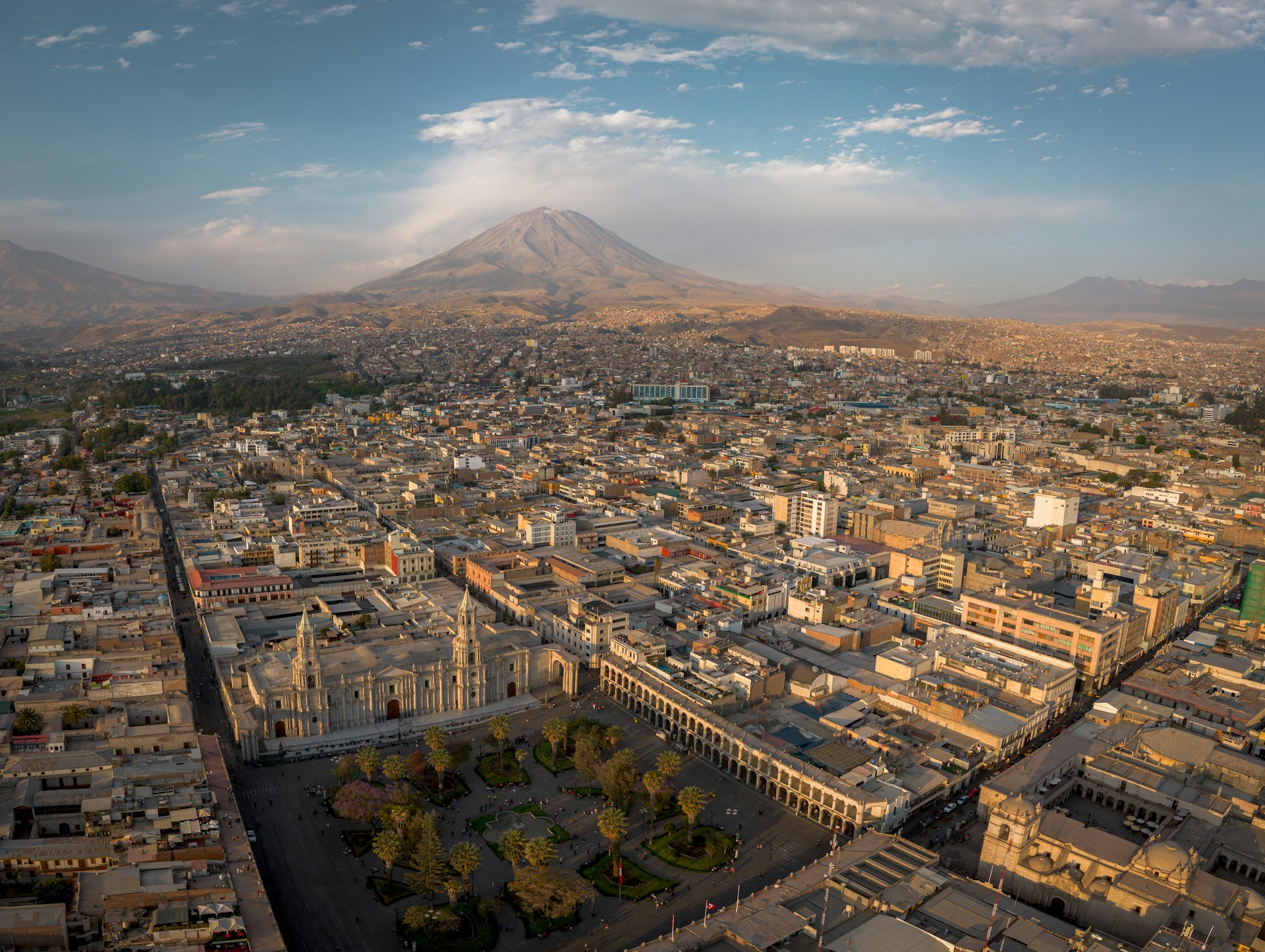
Arequipa was one of my favourite cities to simply wander around. Much of the historic centre is built from pale volcanic sillar stone, and in the sunshine the buildings almost seemed to glow.
The Plaza de Armas was particularly beautiful, especially with the cone of Misti rising behind the cathedral.
My highlight was Santa Catalina Monastery. I expected a conventional historic building, but once inside I found an entire maze of narrow streets, courtyards and little plazas.
The deep blue and terracotta walls made it one of the most colourful places I visited in Peru, and I spent far longer exploring it than I'd planned.
I also ate extremely well in Arequipa. One thing I highly recommend trying is queso helado, the city's traditional frozen dessert. Despite the name, which translates as "frozen cheese", there's no cheese in it.
It's a creamy, ice cream-like dessert traditionally made with milk, sugar, cinnamon, coconut and spices such as cloves. I loved the combination of sweetness, cinnamon and coconut, especially after walking around in the afternoon sun.
Arequipa gave me history, architecture and food without ever feeling rushed.
How Arequipa fits into your Peru itinerary
Arequipa fits perfectly into a southern Peru route, particularly after Nazca or before Lake Titicaca. I'd spend two or three nights here before continuing into Colca Canyon, which is the natural next stop.
Visit Santa Catalina in the late afternoon if you can. The softer light brings out the colours beautifully and makes the monastery particularly photogenic.
Cusco and the Sacred Valley
(pronounced: KOOS-koh)
Cusco and the Sacred Valley at a glance
Southern Peruvian Andes
Inca history, archaeology, markets, and mountain scenery
4-5 nights
History lovers, culture seekers, and active travellers
Historic, atmospheric, colourful, mountainous
May to September
Cusco was somewhere I initially thought of as the gateway to Machu Picchu, but it quickly became one of my favourite destinations in Peru in its own right.
I loved walking around the Plaza de Armas and through San Blas, but what fascinated me most was seeing Inca stonework incorporated directly into later Spanish buildings.
At Sacsayhuamán, the scale became even more impressive. Some of the stones were enormous, yet they fit together with extraordinary precision.
I also spent time exploring the Sacred Valley, and I was glad I didn't treat it as a single rushed day trip.
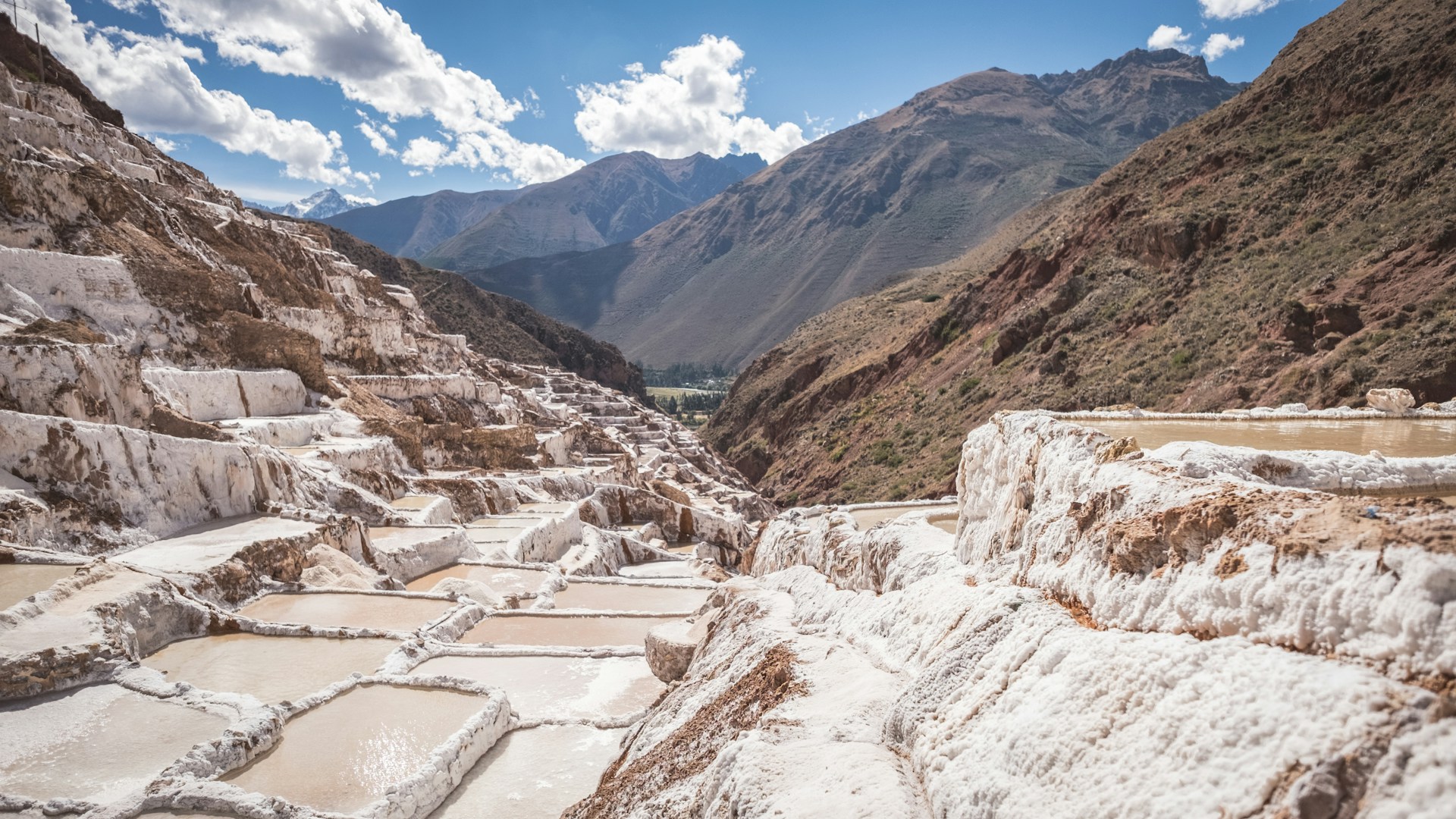
I wandered through Pisac, saw the geometric salt pools at Maras, and explored Ollantaytambo, where huge agricultural terraces climb the mountainside above the town.
What I particularly liked about Ollantaytambo was that Inca history wasn't confined to an archaeological site. I could walk along narrow streets laid out centuries ago, with water still flowing through channels beside them.
The valley also sits lower than Cusco, so spending time there gave me a gentler introduction to the altitude before continuing higher into the Andes.
How Cusco and the Sacred Valley fit into your Peru itinerary
I'd give Cusco and the Sacred Valley at least four nights before Machu Picchu, splitting my time between the city and the valley rather than basing myself entirely in Cusco.
Ollantaytambo is especially convenient because trains to Machu Picchu depart from there, making it an easy final stop before continuing to Aguas Calientes.
If you're arriving from near sea level, don't schedule your biggest hike for your first full day. I found it much more enjoyable to explore Cusco slowly while adjusting to the altitude.
Machu Picchu
(pronounced: MA-choo PEEK-choo)
Machu Picchu at a glance
Cusco Region, southern Peru
Inca history, archaeology, mountain scenery, and hiking
1-2 nights
History lovers, hikers, and first-time Peru travellers
Dramatic, mysterious, mountainous, and unforgettable
May to September
I'd seen the classic photograph of Machu Picchu hundreds of times before I went, so part of me wondered whether the reality could possibly match the image. It did.
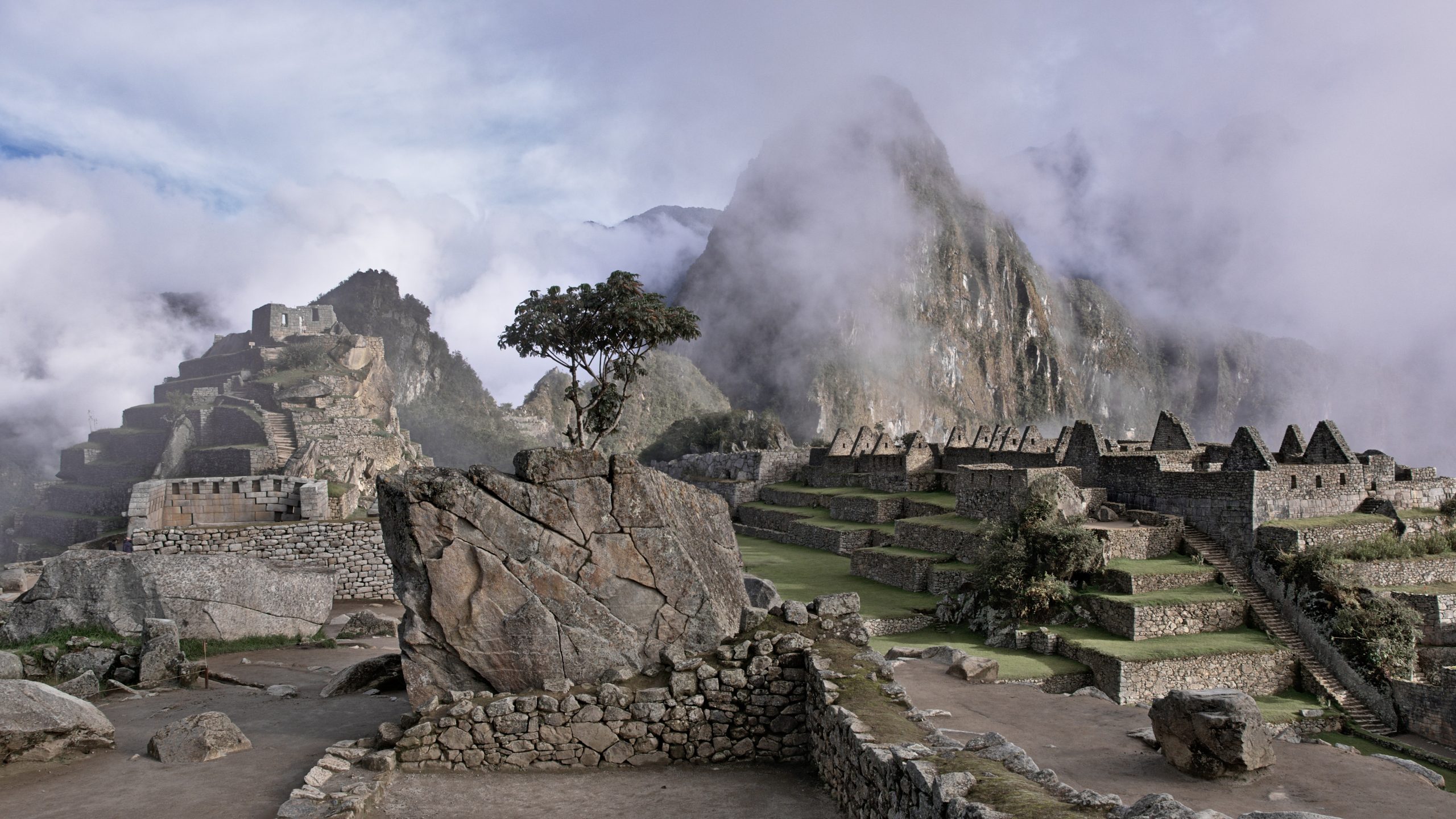
My first proper view across the terraces towards Huayna Picchu stopped me in my tracks.
Clouds were still hanging around the surrounding mountains, and as they shifted, more of the ruins and impossibly steep landscape appeared. It was one of those rare travel moments when I didn't immediately reach for my camera. I just wanted to look at it.
Walking through the site made it even more impressive. From a distance, Machu Picchu looked almost impossibly picturesque.
Up close, I started noticing the carefully fitted stonework, temples, plazas, agricultural terraces and water channels that made this a functioning Inca settlement rather than simply a beautiful ruin.
The setting was what stayed with me most, though. Mountains dropped steeply towards the Urubamba River in almost every direction, making the entire city seem improbably balanced on its ridge.
Machu Picchu was Peru's most famous attraction, but for me, it absolutely earned that reputation.
How Machu Picchu fits into your Peru itinerary
I'd visit after spending several days acclimatising in Cusco and the Sacred Valley, with Ollantaytambo making a convenient departure point for the train.
Staying overnight in Aguas Calientes also gave me more flexibility than trying to travel from Cusco, visit the ruins and return all in one day.
Don't assume there's one standard Machu Picchu ticket. Entry is divided into specific circuits and routes, which determine which parts of the site and viewpoints you can access, so check your chosen circuit carefully before booking.
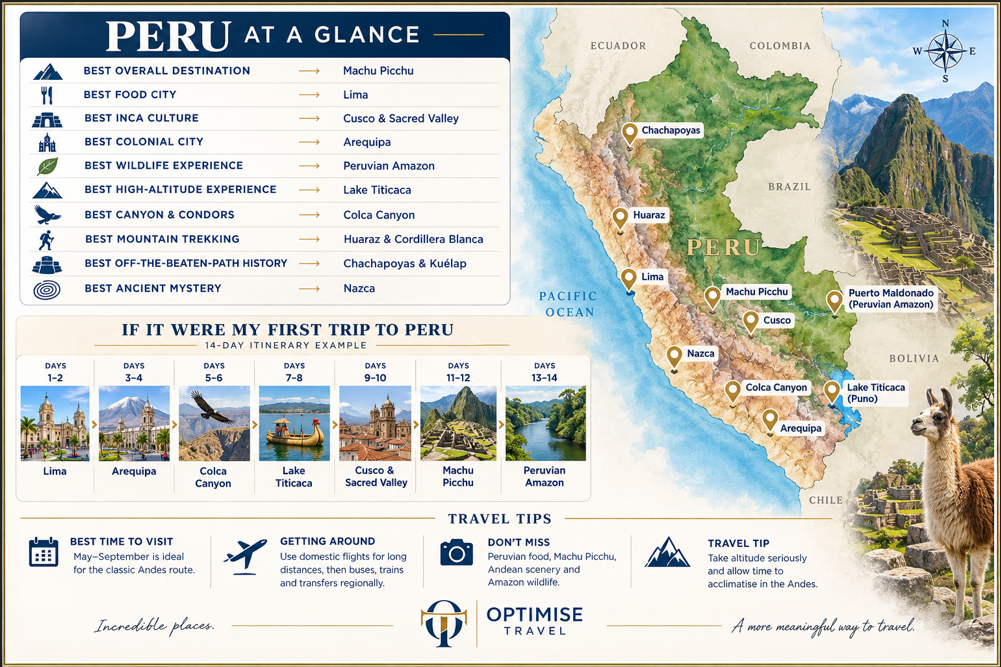
Peru covers everything from Pacific desert and Amazon rainforest to some of the highest mountains in the Andes, so I wouldn't try to connect all 10 destinations in one trip.
For a first visit, I'd focus on southern Peru, where many of the country's biggest highlights connect naturally, and use domestic flights when they save a full day of overland travel.
Peru itinerary: 7 days
Route: Lima → Cusco → Sacred Valley → Machu Picchu
| Days 1-2 | Day 3 | Day 4-5 | Days 6-7 |
|---|---|---|---|---|
Destination | Lima | Fly to Cusco | Cusco & Sacred Valley | Machu Picchu |
Overnight | Lima | Cusco | Cusco / Ollantaytambo | Aguas Calientes / Cusco |
Why this route? For a Peru itinerary of 7 days, I'd stick to the essentials rather than spend too much time travelling.
You'll get Lima's brilliant food scene, Inca history in Cusco, the archaeological sites and mountain scenery of the Sacred Valley, and enough time to experience Machu Picchu without treating it as a rushed day trip.
*I'd fly from Lima to Cusco and spend the first day at altitude taking things relatively slowly. If possible, I'd also spend a night in Ollantaytambo before Machu Picchu rather than travelling all the way from Cusco that morning.
Peru itinerary: 10 days
Route: Lima → Arequipa → Colca Canyon → Cusco → Sacred Valley → Machu Picchu
| Days 1-2 | Day 3-4 | Days 5-6 | Days 7-10 |
|---|---|---|---|---|
Destination | Lima | Arequipa | Colca Canyon | Cusco, Sacred Valley & Machu Picchu |
Overnight | Lima | Arequipa | Colca Canyon | Cusco / Ollantaytambo / Aguas Calientes |
Why this route? For a Peru itinerary of 10 days, I think this strikes a good balance between cities, food, wildlife, history and mountain scenery.
You'll experience Lima and Arequipa before seeing Andean condors in Colca Canyon, then finish with the Inca sites around Cusco, the Sacred Valley and Machu Picchu.
*I wouldn't add Lake Titicaca to this itinerary unless you're comfortable travelling quite quickly. I'd rather have time to properly enjoy Arequipa, Colca and the Cusco region than collect another destination with only a few hours there.
Peru itinerary: 14 days
Route: Lima → Arequipa → Colca Canyon → Lake Titicaca → Cusco → Sacred Valley → Machu Picchu → Peruvian Amazon
Week 1 | Days 1-2 | Days 3-4 | Days 5-6 | Day 7 |
|---|---|---|---|---|
Destination | Lima | Arequipa | Colca Canyon | Travel to Lake Titicaca |
Overnight | Lima | Arequipa | Colca Canyon | Travel to Lake Titicaca |
Week 2 | Days 8 | Days 9-10 | Days 11-12 | Day 13-14 |
|---|---|---|---|---|
Destination | Lake Titicaca | Cusco & Sacred Valley | Machu Picchu | Peruvian Amazon |
Overnight | Puno / island homestay | Cusco / Ollantaytambo | Aguas Calientes / Cusco | Amazon lodge |
Why this route? For a Peru itinerary of 14 days, I'd use the extra time to show just how varied the country is.
You'll go from Lima's Pacific coastline to Arequipa and Colca Canyon, cross the high-altitude landscapes around Lake Titicaca, explore the heart of the Inca Empire, visit Machu Picchu, and finish surrounded by rainforest and wildlife in the Amazon.
*I wouldn't try to squeeze Nazca, Huaraz or Chachapoyas into these itineraries as well. Nazca works particularly well on a longer overland journey down the coast, while Huaraz and Chachapoyas both deserve dedicated detours. If trekking were my main priority, I'd build a different Peru itinerary around Huaraz rather than forcing it into the classic southern route.
Why Peru deserves more than one trip
Peru is one of those countries where I quickly realised that Machu Picchu was only a small part of what made it worth exploring.
Some of my favourite experiences felt like they belonged to completely different trips, from eating ceviche in Lima and watching condors soar over Colca Canyon to hiking beneath glaciers near Huaraz and waking up surrounded by wildlife in the Amazon.
What amazed me was how dramatically Peru changed as I travelled through it.
I found Pacific desert, snow-covered Andes, high-altitude lakes, cloud forest, enormous canyons, ancient cities and tropical rainforest, alongside regional food and cultures that changed with the landscape.
If it's your first visit, don't feel like you need to see all 10 places. I'd choose a route that gives you time to properly experience each stop, then save northern Peru, Huaraz, the Amazon or another region for a trip of its own.
FAQs about visiting Peru
Peru uses the Peruvian sol (PEN). Cards are widely accepted in major cities and tourist areas, but I’d still carry some cash for markets, small restaurants, taxis and more remote destinations.
It depends on your nationality. Travellers from many countries can enter Peru for tourism without obtaining a visa in advance, but permitted stays and entry requirements vary, so check the latest requirements with Peru’s immigration authorities before travelling.
I used a mixture of domestic flights, buses, trains and organised transfers. Peru is much larger than it can appear on a map, so I’d fly longer routes such as Lima to Cusco and save buses or private transfers for shorter regional journeys.
Spanish is the language you'll encounter most often. Peru also recognises Quechua, Aymara and other Indigenous languages as official where they predominate, so you'll hear different languages as you travel through the Andes and other regions.
Peru commonly uses Type A and Type C plugs, and the electricity supply is generally 220V at 60Hz. If you're travelling from a country with different sockets, I'd pack a universal travel adapter and check that your electronics can handle 220V before plugging them in.
Ready to explore Peru? Optimise Travel is here to help
Peru packs an incredible amount into one country, and deciding how to divide your time between its ancient Inca sites, Andean mountains, Amazon rainforest, desert landscapes, historic cities, and world-famous food scene can be surprisingly difficult.
At Optimise Travel, we create personalized travel itineraries based on your interests, travel style, and budget.
Whether you're dreaming of exploring Cusco and the Sacred Valley, finally seeing Machu Picchu, eating your way through Lima, watching condors in Colca Canyon, hiking beneath the peaks of the Cordillera Blanca, or heading deep into the Peruvian Amazon, we'll help you build an itinerary that makes the most of your time.
If you'd like help planning your trip to Peru, click here to learn more about our concierge travel services.