

Ask ChatGPT to plan your trip, and you'll have a rough itinerary in under a minute, which is genuinely impressive and worth taking seriously. It's become a normal first step for a lot of travellers, and there's a good reason for that.
The honest comparison between a human travel planner and an AI trip planner isn't AI good, human bad, or the other way round. AI is a strong starting point.
A human planner earns their fee on the parts AI still gets wrong: current details, judgment calls, and someone to call when a plan needs to change. Here's an honest look at both, so you can work out which one your trip actually needs.
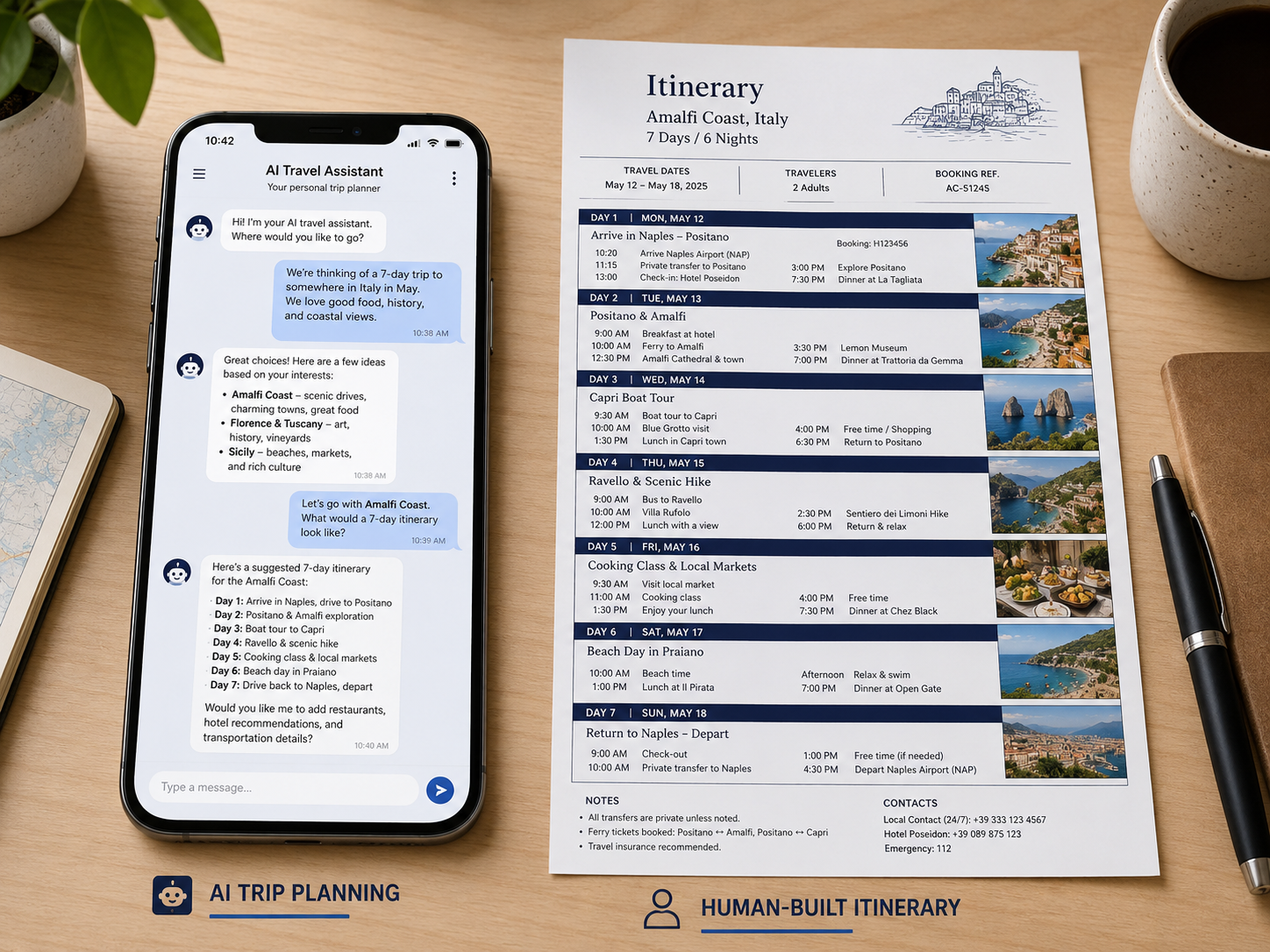
Human vs AI travel planner: the quick answer
At a glance, before the detail:
Factor | AI trip planner | Human travel planner |
|---|---|---|
Speed | Seconds to minutes | Usually a few days |
Cost | Free or very cheap | A planning fee, typically |
Personalisation | Based on what you type in | Based on an actual conversation |
Accuracy of details | Can be outdated or invented | Verified, current knowledge |
Real-time problem-solving | None | Yes, if something changes |
Accountability | Nobody to call if it's wrong | A real person responsible |
Best suited for | Simple trips, quick inspiration | Complex, high-value, or unfamiliar trips |
*Treat this as a general pattern. Both AI tools and human planners vary in quality, and the gap is narrower for a simple trip than a complicated one.
What AI trip planners actually do well
Credit where it's due, because this is the part most comparisons skip past too quickly:
Where AI trip planners fall short
Specific, documented limitations, not vague scepticism:
What a human travel planner does that AI still can't
The flip side, and where the fee genuinely goes:
None of this is about AI being untrustworthy. It's that a language model has never actually walked the route, sat in the restaurant, or found out the hard way that a connection is tighter than it looks on paper.
When AI planning is enough, and when you need a human
A practical split, rather than a universal rule:

Can you use both AI and a travel planner?
Plenty of travellers do, and it's a genuinely sensible approach rather than a compromise. Use an AI tool for the early brainstorm, a rough shape, a few ideas you wouldn't have thought of.
Then bring in a human planner to verify the details, personalise it properly, and handle the logistics that actually make it work. The AI draft doesn't go to waste. It just stops being the final plan.
Get a trip planned by someone who's actually been there
AI trip planners are a genuinely useful starting point, fast, free, and good for a rough shape. What they can't do yet is verify a detail, make a judgement call, or pick up the phone when something changes.
That's where a human planner earns their place, and it's the gap our service is built to close.
If you'd rather start with a plan that's already been checked against reality, start planning with our personalised travel planning service, and see exactly what's included when you talk to us.
Frequently asked questions
AI travel recommendations should be verified before you book anything, especially hotels, transportation, tours, and attractions. Check current prices, opening hours, availability, cancellation policies, and other important details directly with the provider or a reliable current source.
Yes, some human travel planners use AI tools to help with research, brainstorming, or other parts of the planning process. The difference is that a human planner can review the information, verify important details, and apply their own experience and judgement before recommending it to a traveller.
Fact-check an AI travel itinerary by verifying hotels, attractions, transportation, opening hours, prices, travel times, and entry requirements with current authoritative sources. Pay particular attention to anything that could affect whether the itinerary is actually possible.
If something goes wrong on a trip planned by AI, there's typically nobody responsible for fixing it, since the tool doesn't offer ongoing support. A human planner can usually step in, adjust the plan, and help resolve the issue directly.
Yes, AI can help organise an existing trip by suggesting activities, restaurants, day trips, packing lists, and ways to fill gaps in your itinerary. Providing your confirmed dates, accommodation, and bookings gives the AI more context for its recommendations.