

Albania surprised me more than I expected. I found Ottoman towns tucked beneath mountains, ancient ruins surrounded by countryside, dramatic hiking trails, and some of the clearest water I've seen along the Mediterranean.
What I loved most was that so much of it still felt relatively undiscovered.
Albania has changed enormously since opening to the world in the 1990s, but it hasn't lost that sense of discovery. These are the 10 places I'd make room for on your first trip.
Have You Seen Our Travel Concierge Service?
Your trip, planned by local experts
We are not a travel agent - we design custom itineraries around your budget and style, without receiving commissions or booking fees.
Custom itinerary
Built around your dates, budget, and travel style.
Local expert knowledge
Recommendations from people on the ground, not review sites.
Travel smarter, spend less
We optimise for your budget to make your money go further.
Shkodër
(pronounced: SHKOH-der)
Shkodër at a glance
Northwestern Albania, near Lake Shkodër and the Montenegro border
Castles, lake scenery, cycling, and northern Albanian culture
1-2 nights
History lovers, road trippers, cyclists, and travelers heading into the Albanian Alps
Historic, relaxed, multicultural, and outdoorsy
April to October
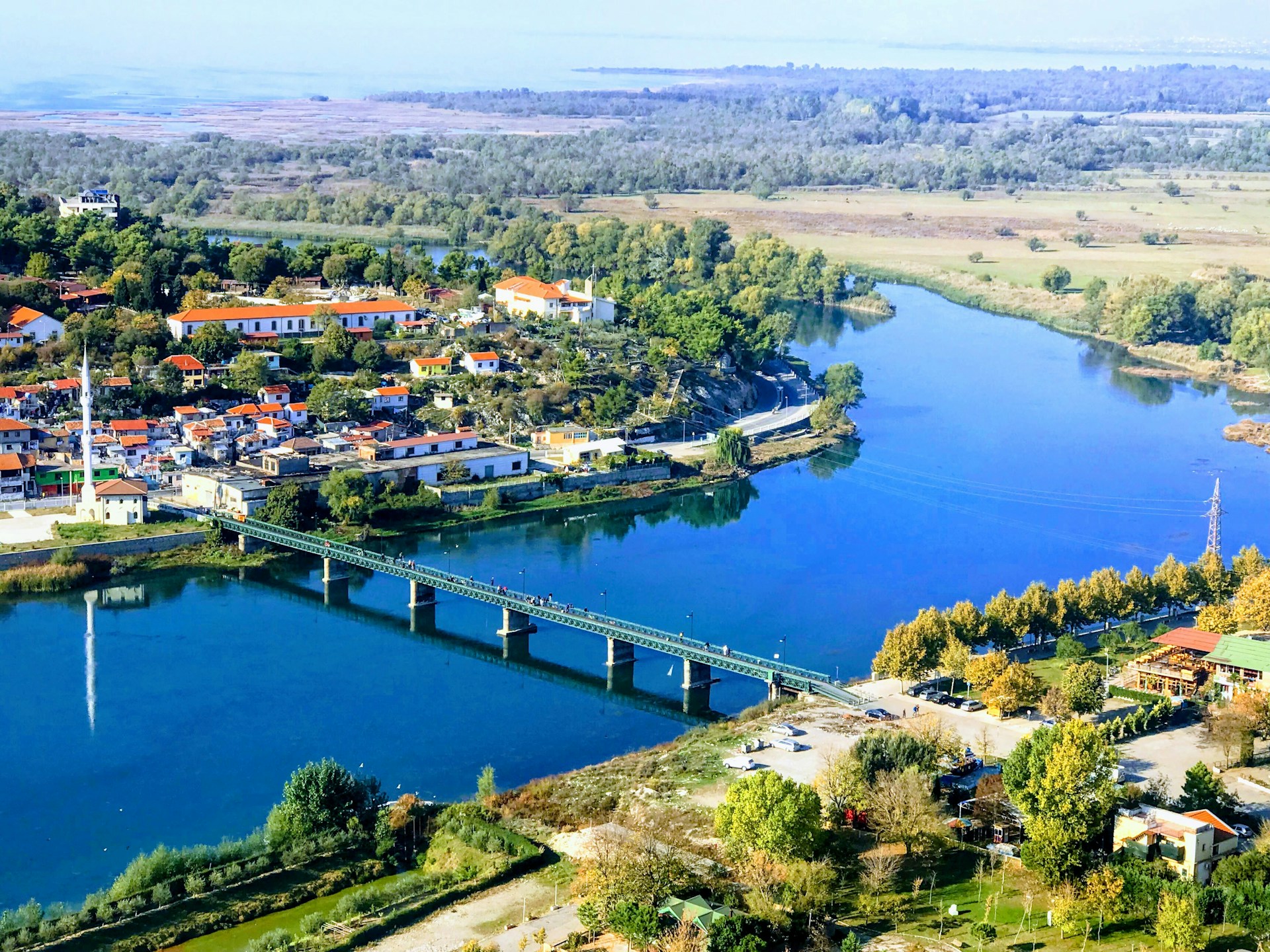
Shkodër felt like a natural introduction to northern Albania. The mountains were getting closer, Lake Shkodër stretched toward Montenegro, and the city itself had a wonderfully relaxed pace that made me want to slow down.
Rozafa Castle was the obvious place to start. People have fortified this hill for well over two thousand years, and walking through the layers of ruins gave me perspective on how many civilizations have passed through this part of Albania.
The climb was worth it for the view alone, with the lake, rivers, countryside, and distant mountains all spreading out below.
Back in town, I preferred simply wandering. Shkodër has a fascinating mix of religious and cultural influences, and I loved seeing mosques and Catholic and Orthodox churches sharing the same cityscape.
The pedestrian streets and old center were particularly enjoyable early in the day before everything became busier.
I'd also make time for the lake. Shiroka is only a short trip from the center and made an easy escape for views across the water. This is where I'd stop for lunch and try the local Koran trout, one of the foods particularly associated with Lake Shkodër.
How Shkodër fits into your Albania itinerary
Shkodër makes a natural first or last stop in northern Albania and pairs particularly well with Theth and the Albanian Alps. It's also an easy addition if you're crossing between Albania and Montenegro.
If you're continuing into the Albanian Alps, use Shkodër to organize your onward transport. It's the main jumping-off point for Theth and the Komani Lake route, so an overnight here can make the journey north considerably easier.
Tirana
(pronounced: tee-RAH-nah)
Tirana at a glance
Central Albania
Food, nightlife, history, and city exploring
2 nights
Foodies, city breakers, and first-time visitors
Colorful, energetic, youthful, and constantly changing
April to June and September to October
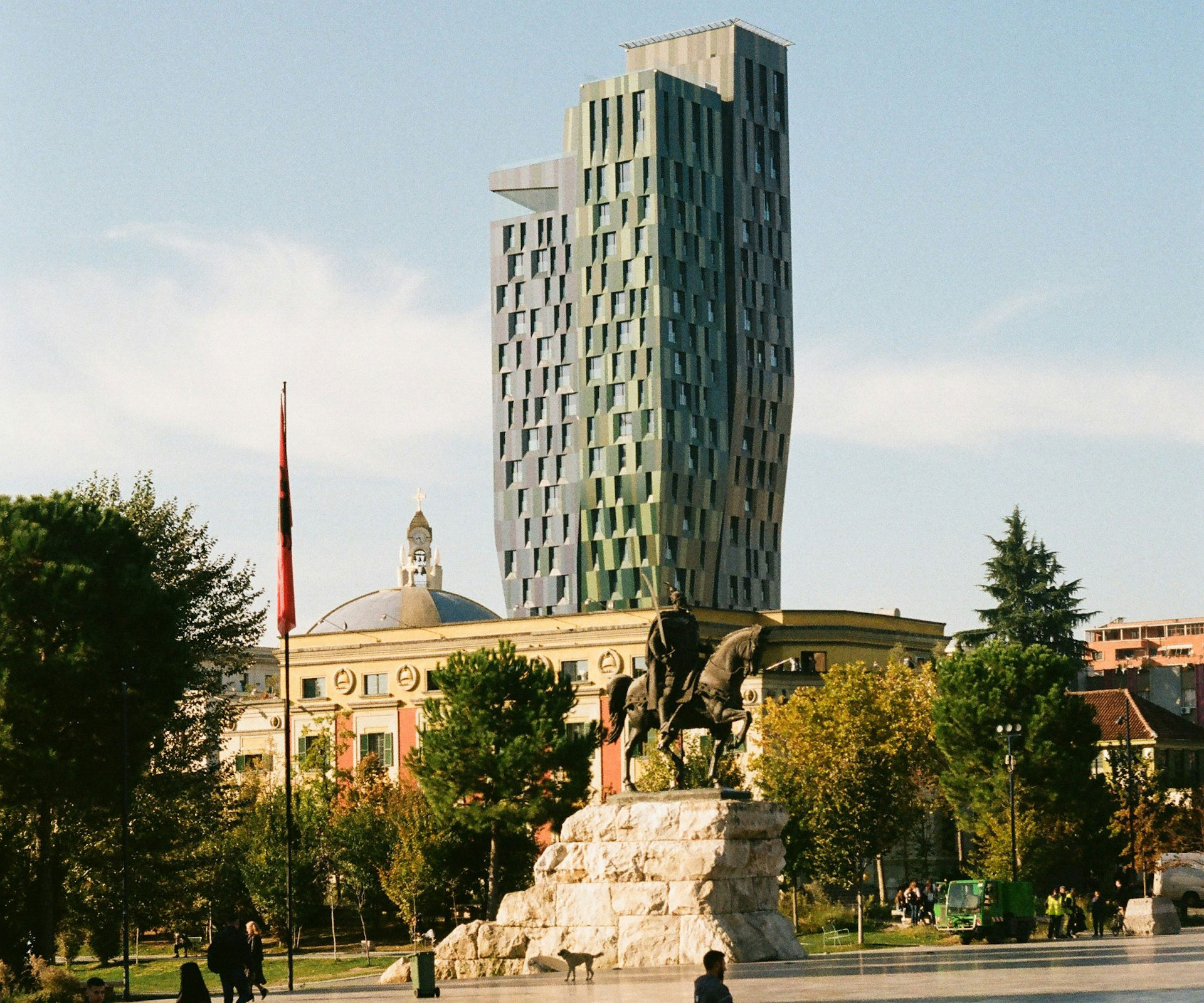
Tirana wasn't the Albania of stone villages and dramatic coastlines I'd pictured before my trip, but I really enjoyed the city's energy. It's colorful, busy, slightly chaotic, and full of reminders of how dramatically Albania has changed in little more than a generation.
I spent plenty of time walking, particularly around Skanderbeg Square and Blloku. The latter fascinated me because this was once an exclusive neighborhood reserved for Albania's Communist elite.
Today, it's packed with restaurants, cafes, bars, and people staying out late.
I also couldn't miss the Pyramid of Tirana, one of the strangest remnants of the country's Communist era, although its transformation into a modern cultural and technology space says a lot about Tirana today.
One experience I'd definitely make time for is the Dajti Ekspres cable car. The ride takes around 15–20 minutes each way as it climbs toward Mount Dajti, and I thought it was well worth doing even on a cloudy day.
The views changed constantly as we climbed above Tirana, and it gave me a completely different perspective on the size and setting of the city.
Then there was the food. I loved trying dishes like byrek and tavë kosi, along with the grilled meats that seemed to appear everywhere. Tirana was also noticeably easier on my budget than many other European capitals I've visited.
How Tirana fits into your Albania itinerary
Tirana is the natural starting and finishing point for most Albania itineraries. I'd spend two nights here before heading north toward Shkodër or south toward the country's historic towns and Ionian coast.
Don't save the Dajti cable car exclusively for perfect weather. Clear skies obviously give you better long-distance views, but I still thought the 15–20 minute journey was worthwhile on a cloudy day.
Butrint
(pronounced: BOOT-rint)
Butrint at a glance
Southern Albania, near Sarandë and the Greek border
Ancient ruins, archaeology, photography, nature, and history
Half day
History lovers and curious explorers
Ancient, atmospheric, peaceful, and surprisingly wild
April to June and September to October
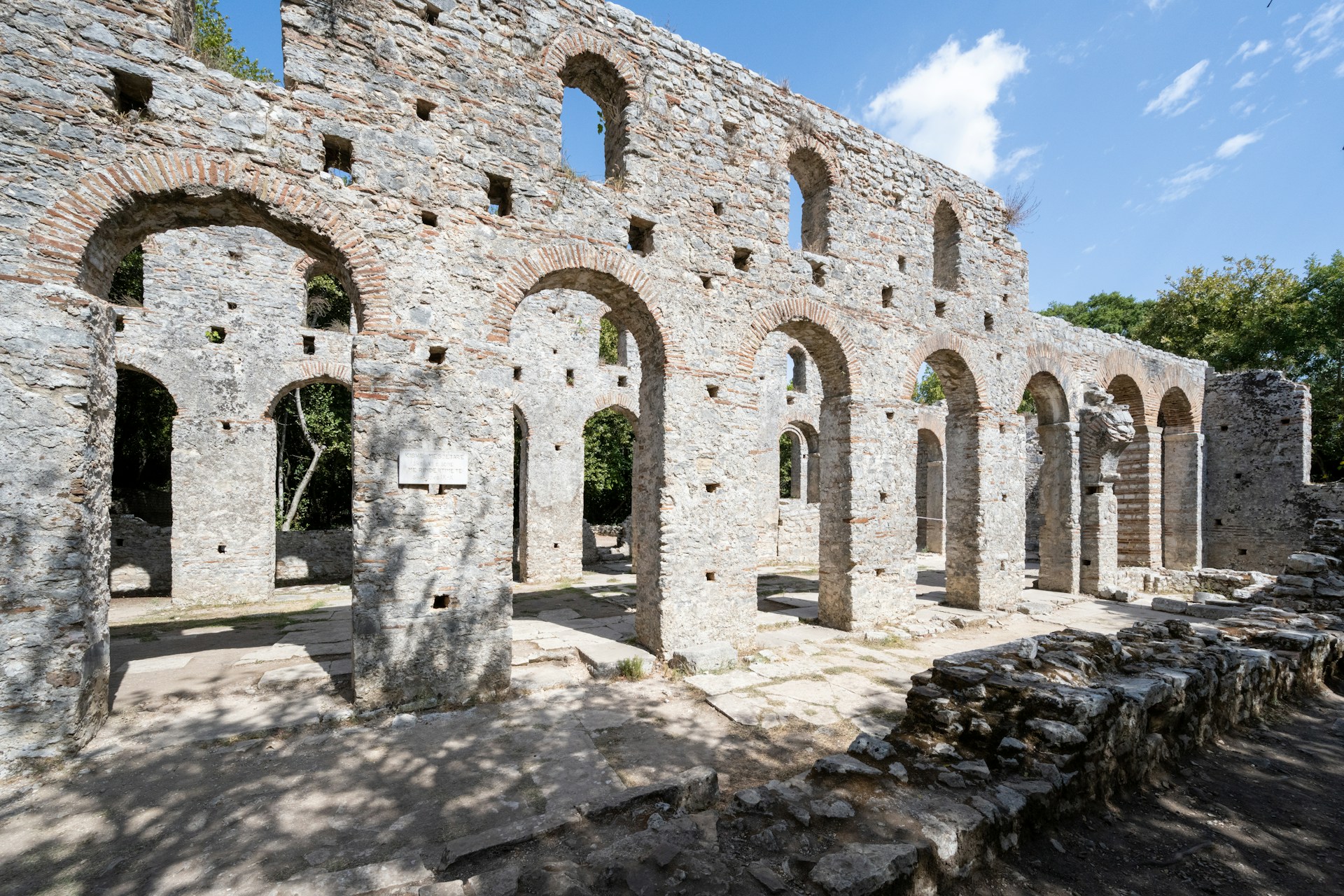
My advice before visiting Butrint is surprisingly practical: make sure your phone has plenty of storage space. I couldn't stop taking pictures here.
Part of that was the ruins themselves, but the setting made Butrint particularly memorable for me.
The ancient city occupies a forested peninsula surrounded by water and wetlands, so I'd walk from Greek and Roman ruins into stretches of greenery that almost seemed to be reclaiming them.
The history is remarkable. Butrint was inhabited for well over two thousand years, and I could see evidence of Greek, Roman, Byzantine, Venetian, and Ottoman occupation as I explored.
I particularly loved the ancient Greek theatre, tucked into the trees with plants growing around its stone seats.
Elsewhere I found Roman remains, Byzantine buildings, defensive walls, and the beautiful mosaic floor of the early Christian baptistery.
Everywhere I looked seemed to offer another photograph: columns reflected in the water, ruins beneath enormous trees, old stone walls covered in greenery, and views across the lagoon.
That's what separated Butrint from some of the more manicured archaeological sites I've visited. It still felt a little wild.
I'd give yourself at least three hours rather than treating it as a quick stop. There's far more here than I expected.
How Butrint fits into your Albania itinerary
Butrint is an easy half-day trip from Sarandë and pairs perfectly with nearby Ksamil, making the two a natural full day while exploring southern Albania.
I'd arrive early in the day. Butrint's combination of ruins, forest, and water is particularly atmospheric when it's quieter, and you'll have more time to explore before continuing to Ksamil.
Blue Eye
(Syri i Kaltër, pronounced: see-REE ee KAL-ter)
Blue Eye at a glance
Southern Albania, between Sarandë and Gjirokastër
Natural scenery, photography, short walks, and crystal-clear water
1-2 hours
Nature lovers, photographers, road trippers, and families
Serene, unusual, lush, and almost unreal
April to October
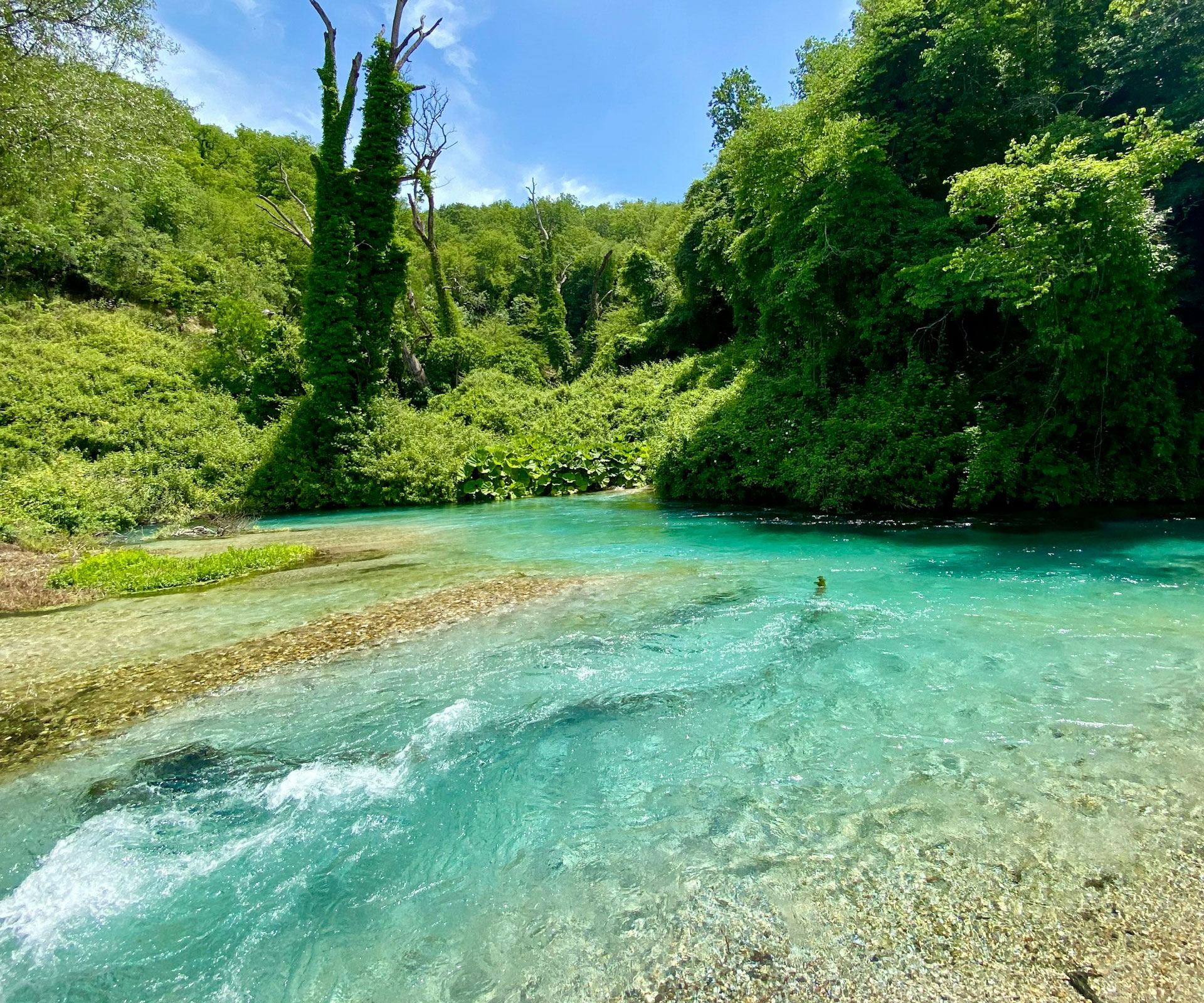
I've seen plenty of beautiful springs and swimming holes on my travels, but the Blue Eye didn't look quite real when I first saw it.
The name made perfect sense once I reached the viewing area.
The spring has an intensely dark blue center surrounded by brilliant turquoise and green water, creating the appearance of an enormous eye beneath the trees. I found myself staring at the center, trying to work out just how deep it went.
That's part of the mystery. Divers have explored the spring, but its full depth has never been conclusively established. The force of the water rising from underground also keeps the surface moving, with sand and sediment swirling below the incredibly clear water.
Getting there added to the experience for me. After leaving the road, I walked through the lush forest before suddenly reaching this burst of almost impossibly bright blue.
I wouldn't plan an entire day around the Blue Eye, though. An hour or two gave me enough time to walk around, take far too many photos, and enjoy the surrounding forest before continuing on.
What I liked most was how such an unusual natural phenomenon could fit so easily into a day of exploring southern Albania.
How the Blue Eye fits into your Albania itinerary
The Blue Eye sits naturally between Sarandë and Gjirokastër, making it an excellent stop while traveling between the coast and Albania's interior rather than a destination that needs its own day.
Don't plan on swimming in the spring itself. Swimming and diving at the Blue Eye have been restricted to protect the site, so I'd visit for the scenery and save your swim for the Albanian Riviera.
Ksamil & the Albanian Riviera
(pronounced: KSAH-meel)
Ksamil & the Albanian Riviera at a glance
Southern Albania, along the Ionian coast
Beaches, swimming, kayaking, coastal drives and boat trips
3-5 nights
Beach lovers, couples, and road trippers
Sunny, laid-back, and lively in summer
May to June and September
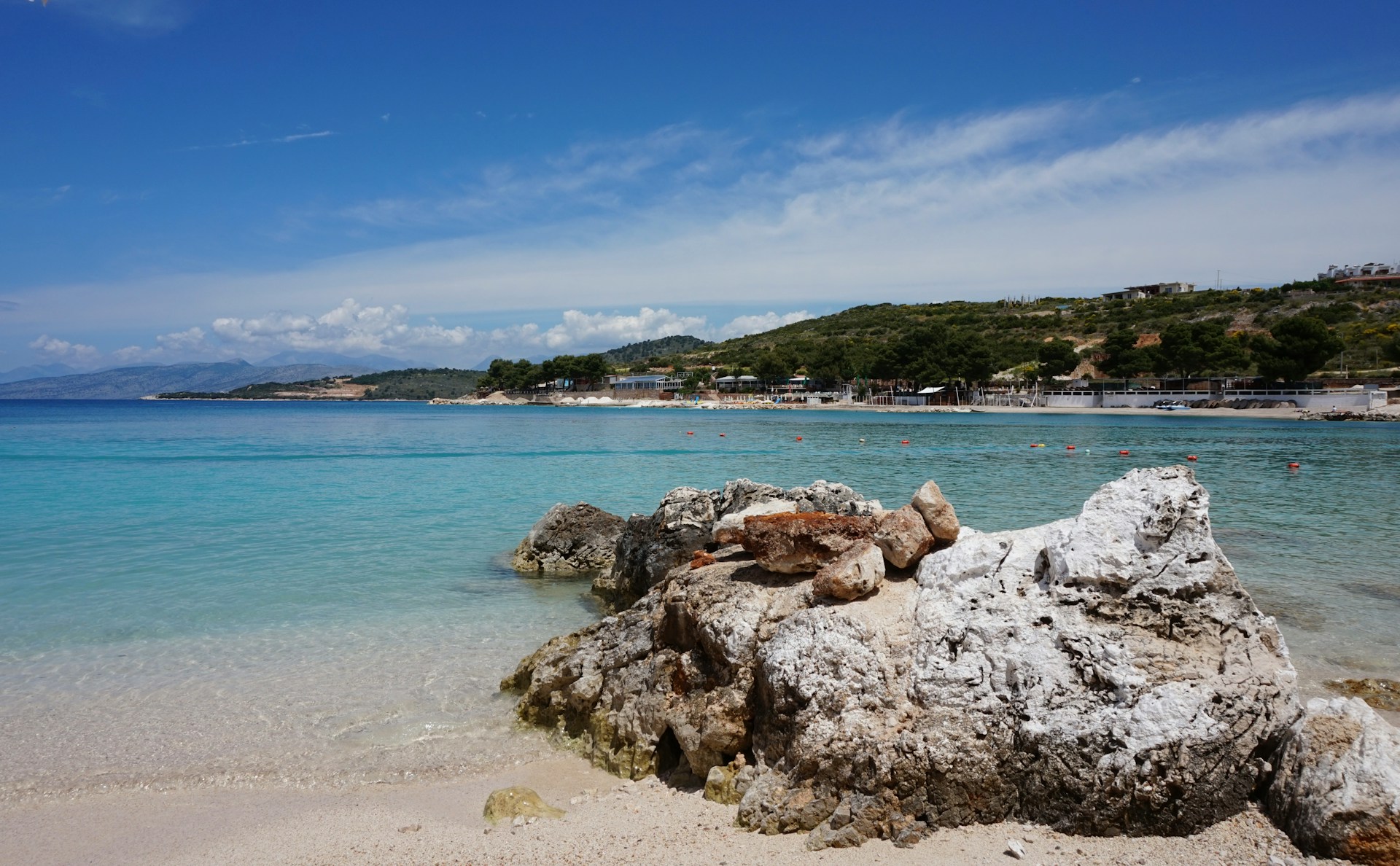
The Albanian Riviera gave me some of the biggest "I can't believe this is Albania" moments of my trip. The combination of steep mountains, tiny coves, and ridiculously clear Ionian water made this one of the parts of the country I most wanted to take slowly.
Ksamil gets most of the attention, and I understood why as soon as I saw the water. Several small islands sit just offshore, close enough to reach by kayak or one of the little boat taxis. I loved being able to get out on the water and see just how clear it really was.
But I wouldn't come all this way and stay only in Ksamil.
Driving the coast between Sarandë and Himarë was one of my favorite experiences on the Riviera.
I especially loved it early in the morning, when there was hardly anyone else around, and I could look down from the cliffs across the Ionian toward Corfu.
Along the way, I found beaches and coves such as Livadhi, Gjipe, and Porto Palermo that made me want to keep pulling over. Some require more effort to reach than others, which was part of the appeal.
Ksamil can get extremely busy during July and August, so for me, the Riviera is much more tempting just outside peak summer.
How Ksamil & the Albanian Riviera fit into your Albania itinerary
I'd give the Riviera at least three nights and combine it with Butrint, Sarandë, and the Blue Eye before continuing inland toward Gjirokastër.
Rent a car if you want to experience more than Ksamil and Sarandë. Having my own transport gave me the freedom to stop at smaller beaches and viewpoints along the coast rather than building the day around bus schedules.
Dhermi
(pronounced: DERR-mee)
Dhermi at a glance
Albanian Riviera, between Vlorë and Himarë
Beaches, boat trips, swimming, and coastal scenery
2-3 nights
Beach lovers, couples, photographers, and road trippers
Beautiful, relaxed, historic, and lively by the beach
May to June and September
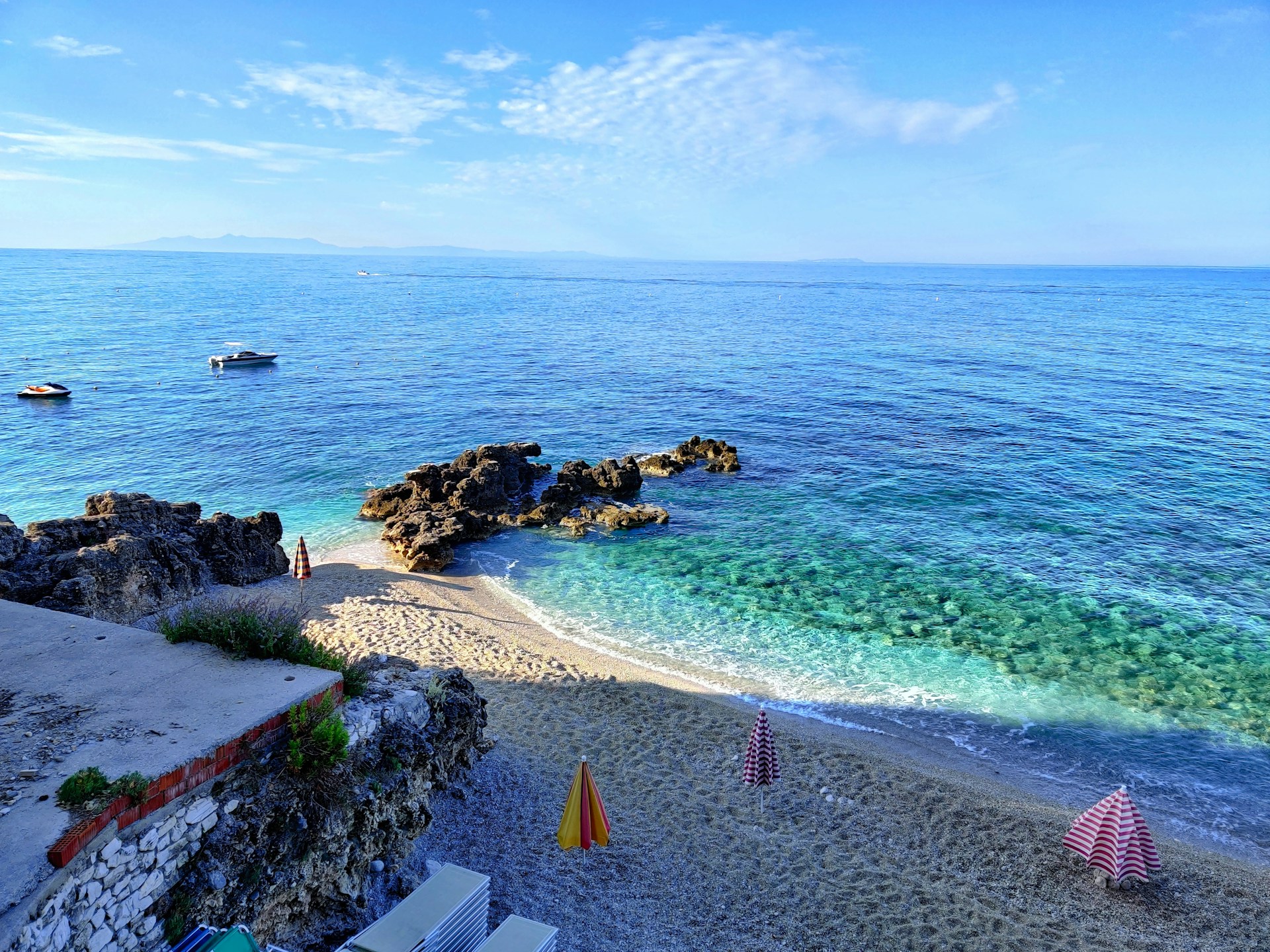
Dhërmi gave me two completely different versions of the Albanian Riviera in one place. Up on the hillside, I found an old stone village surrounded by olive groves, while hundreds of metres below was a long beach backed by some of the clearest Ionian water I'd seen.
I loved wandering around the upper village before heading down to the coast. The stone lanes, old churches, and views through the olive groves made it feel far removed from the busier beach scene below.
Even the winding drive between the two was memorable, with viewpoints that repeatedly tempted me to stop.
One of my favorite things I did here was take a half-day boat tour along the coast. We explored secret caves and little coves tucked beneath the cliffs, stopping at beautiful swimming spots that I never would have found from the road.
It was an excellent way to spend half the day and gave me a completely different view of the Riviera.
Gjipe was another highlight nearby, where a dramatic limestone canyon reaches the Ionian Sea. Between places like this and the smaller coves along the coast, I found that Dhërmi rewarded me most when I ventured beyond its main beach.
How Dhërmi fits into your Albania itinerary
Dhërmi is one of my favorite places to break up a drive along the Albanian Riviera, fitting naturally between Vlorë and Himarë before continuing south toward Sarandë and Ksamil.
I'd split your time between land and sea. Spend a morning exploring the old village, but save half a day for a boat tour.
Some of my favorite swimming spots around Dhërmi were the caves and secluded coves that were much easier to experience from the water.
Valbona Valley
(pronounced: val-BOH-nah)
Valbona Valley at a glance
Albanian Alps, northeastern Albania
Hiking, mountain scenery, guesthouse stays, and outdoor adventures
2-3 nights
Hikers, adventure travelers, photographers, and nature lovers
Remote, rugged, peaceful, and spectacular
June to September
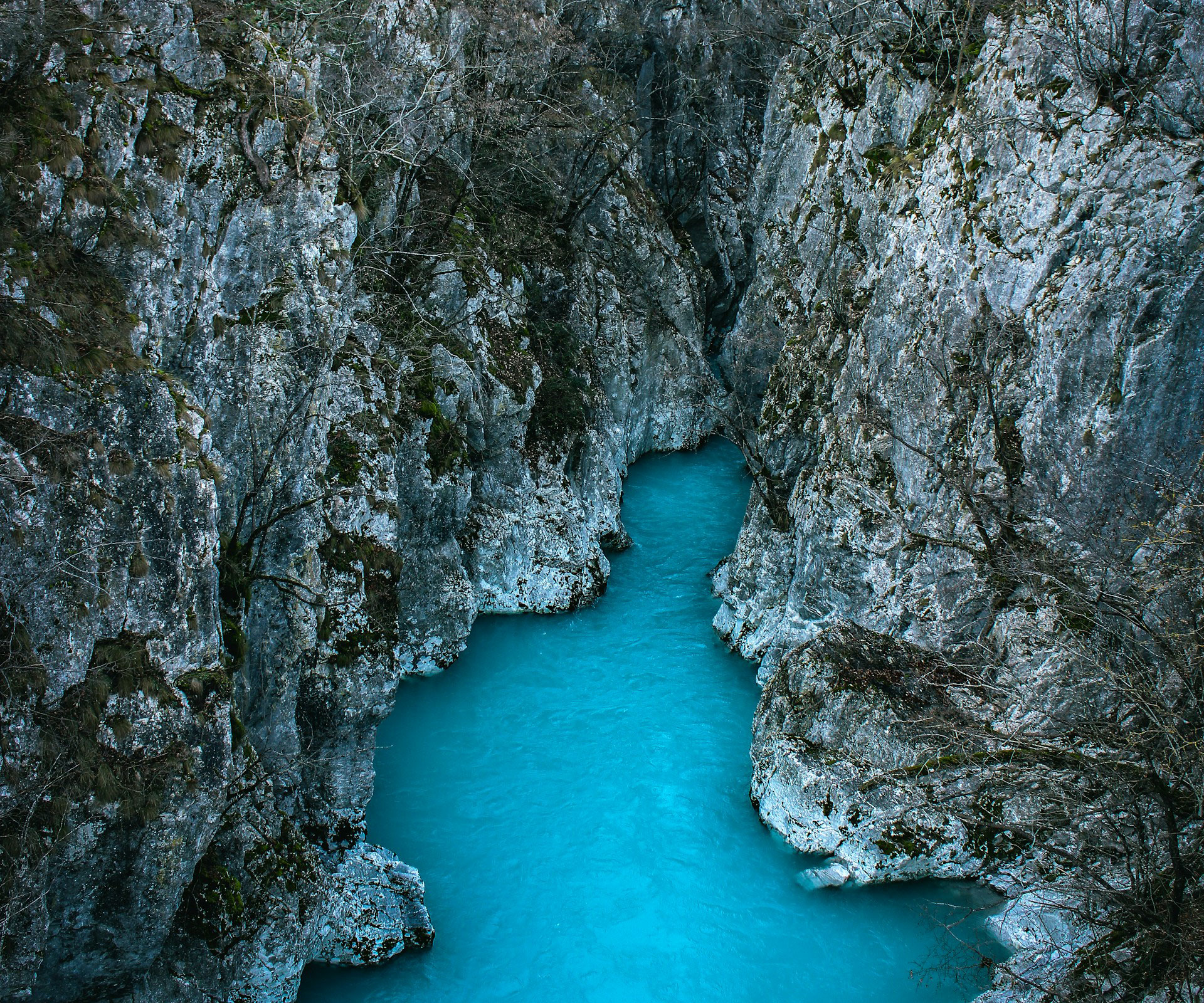
Valbona Valley gave me some of my favorite hiking in all of Albania. The scenery here felt enormous, with steep limestone mountains rising on either side of the valley and the brilliant turquoise Valbona River cutting through the middle.
Even getting there was part of the adventure. The journey from Shkodër can include the Lake Koman ferry, which winds between towering cliffs and steep green mountains.
Rather than feeling like a long transfer day, it became one of the most memorable journeys I made in northern Albania.
Once in Valbona, I loved how simple everything felt. Small guesthouses are scattered through the valley, hiking trails disappear into the mountains, and the whole area still feels considerably more remote than many of Europe's better-known mountain regions.
The standout hike is the trail over Valbona Pass to Theth. Climbing toward the pass was challenging, but the views made every bit of effort worthwhile.
From higher up, I could look back across the green Valbona Valley before eventually descending toward the dramatic limestone peaks surrounding Theth.
If hiking is one of the reasons you're visiting Albania, this is one I'd make room for.
How Valbona Valley fits into your Albania itinerary
I'd visit Valbona after Shkodër, traveling via Lake Koman, then hike over Valbona Pass to Theth. Together, they make an incredible northern Albania mountain circuit rather than two separate stops.
Bring enough cash for your time in the mountains. Guesthouses, meals, transport, and other small purchases may require cash, and I wouldn't rely on being able to find a working ATM or pay by card once you're in the valley.
Theth
(pronounced: TETH)
Theth at a glance
Albanian Alps, northern Albania
Hiking, mountain scenery, waterfalls, traditional villages, and guesthouse stays
2-3 nights
Hikers, adventure travelers, photographers, and nature lovers
Remote, traditional, dramatic, and peaceful
June to September
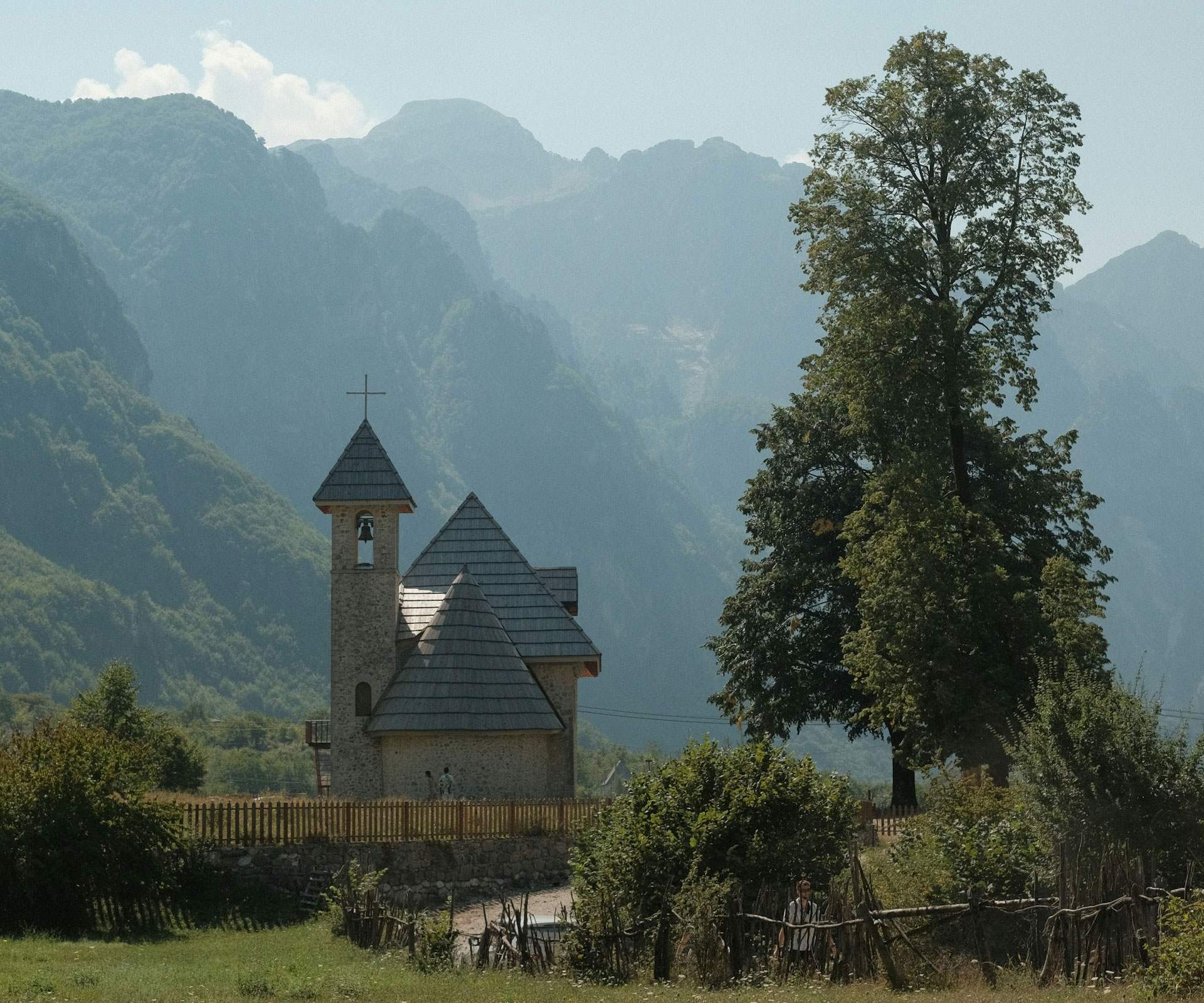
Arriving in Theth felt like I'd reached one of the most isolated corners of Albania. The village sits deep within the Accursed Mountains, with stone houses scattered across the valley floor and enormous limestone peaks rising in almost every direction.
I loved exploring the village itself. The little stone church surrounded by mountains is probably Theth's most recognizable sight, but places like the Kulla were just as interesting to me.
This old lock-in tower is tied to the Kanun, the traditional code that once governed everything from hospitality to blood feuds in these mountain communities.
There was plenty to keep me outside, too. I walked through the valley alongside the Shala River and explored some of the surrounding trails.
One of the most popular excursions is the Blue Eye of Theth, a brilliant turquoise mountain pool hidden in a forested gorge near Nderlysa. Despite the name, it's completely separate from the famous Blue Eye near Sarandë in southern Albania.
But some of my favorite moments in Theth were much simpler. Sitting down for dinner at a family-run guesthouse after a day outside, with the mountains slowly disappearing into darkness around me, was hard to beat.
Meals built around local lamb, cheese, vegetables, and a glass of raki made staying in the valley feel like part of the experience, not just somewhere to sleep.
Theth may be easier to reach than it once was, but thankfully, it still felt wonderfully removed from the rest of Albania.
How Theth fits into your Albania itinerary
Theth pairs perfectly with Valbona Valley. I'd travel from Shkodër to Valbona via Lake Koman, hike over Valbona Pass into Theth, and then return to Shkodër from there.
Stay in a locally run guesthouse and include dinner when you book if it's offered.
Some of my favorite evenings in the Albanian Alps were spent around a guesthouse table, and it was one of the easiest ways I found to experience the food and hospitality of the region.
Gjirokastër
(pronounced: JEER-oh-kah-ster)
Gjirokastër at a glance
Southern Albania, in the Drino Valley
Ottoman architecture, history, castles, and food
2 nights
History and architecture lovers, and couples
Atmospheric, steep, and beautifully preserved
April to June and September to October
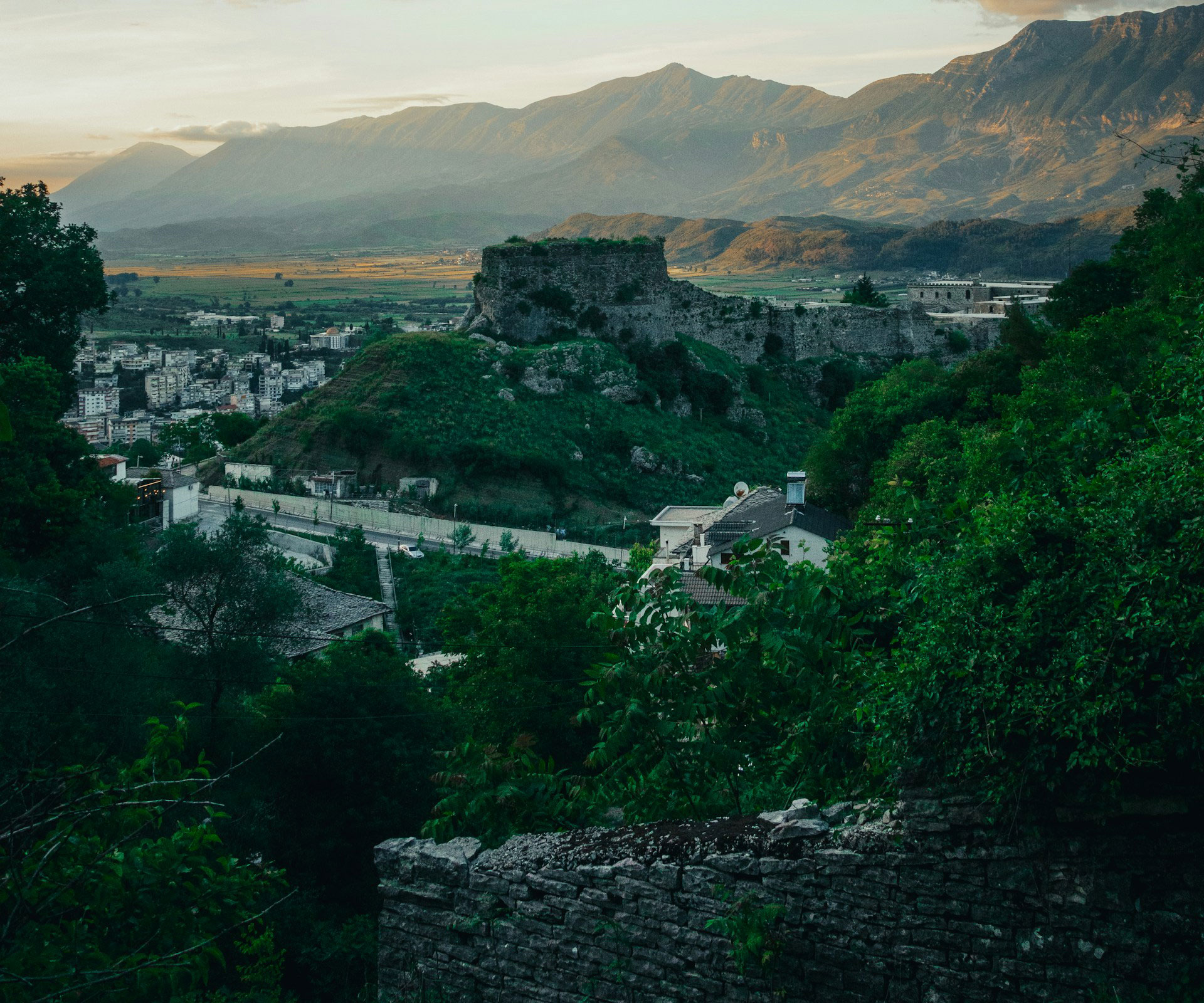
Gjirokastër was one of those places where I wanted to put the map away and simply wander. The old town climbs steeply up the hillside beneath an enormous castle, with cobbled lanes twisting between distinctive stone houses topped by grey slate roofs.
I started with Gjirokastër Castle, which gave me some of the best views over the old town and the Drino Valley.
There's plenty of military history inside, but the exhibit that caught me completely off guard was the remains of a US military jet displayed within the fortress.
Its exact Cold War story is still disputed, which somehow made seeing it inside a centuries-old Albanian castle even stranger.
The old bazaar was the part of Gjirokastër I enjoyed most, especially toward dusk. I loved watching the light change on the stone buildings while the castle loomed above the narrow streets.
Shops, cafes, and small tables spilling outside gave this part of town a completely different atmosphere from the fortress.
I'd also visit at least one of Gjirokastër's traditional fortified houses. Walking through their interiors helped me understand the city far better than simply admiring the architecture from outside.
Two nights felt about right. It gave me time to explore without turning Gjirokastër into another quick sightseeing stop.
How Gjirokastër fits into your Albania itinerary
Gjirokastër fits naturally between Tirana and the Albanian Riviera, and it's particularly easy to combine with the Blue Eye before continuing toward Sarandë, Ksamil, and Butrint.
Wear shoes with decent grip. Gjirokastër's steep, polished cobblestone streets are beautiful, but they're not particularly forgiving, especially after rain.
Berat
(pronounced: beh-RAHT)
Berat at a glance
South-central Albania, on the Osum River
Ottoman architecture, history, food, and castles
2 nights
Photographers, food lovers, and couples
Historic, picturesque, relaxed, and atmospheric
April to June and September to October
Berat was one of the prettiest cities I visited in Albania.
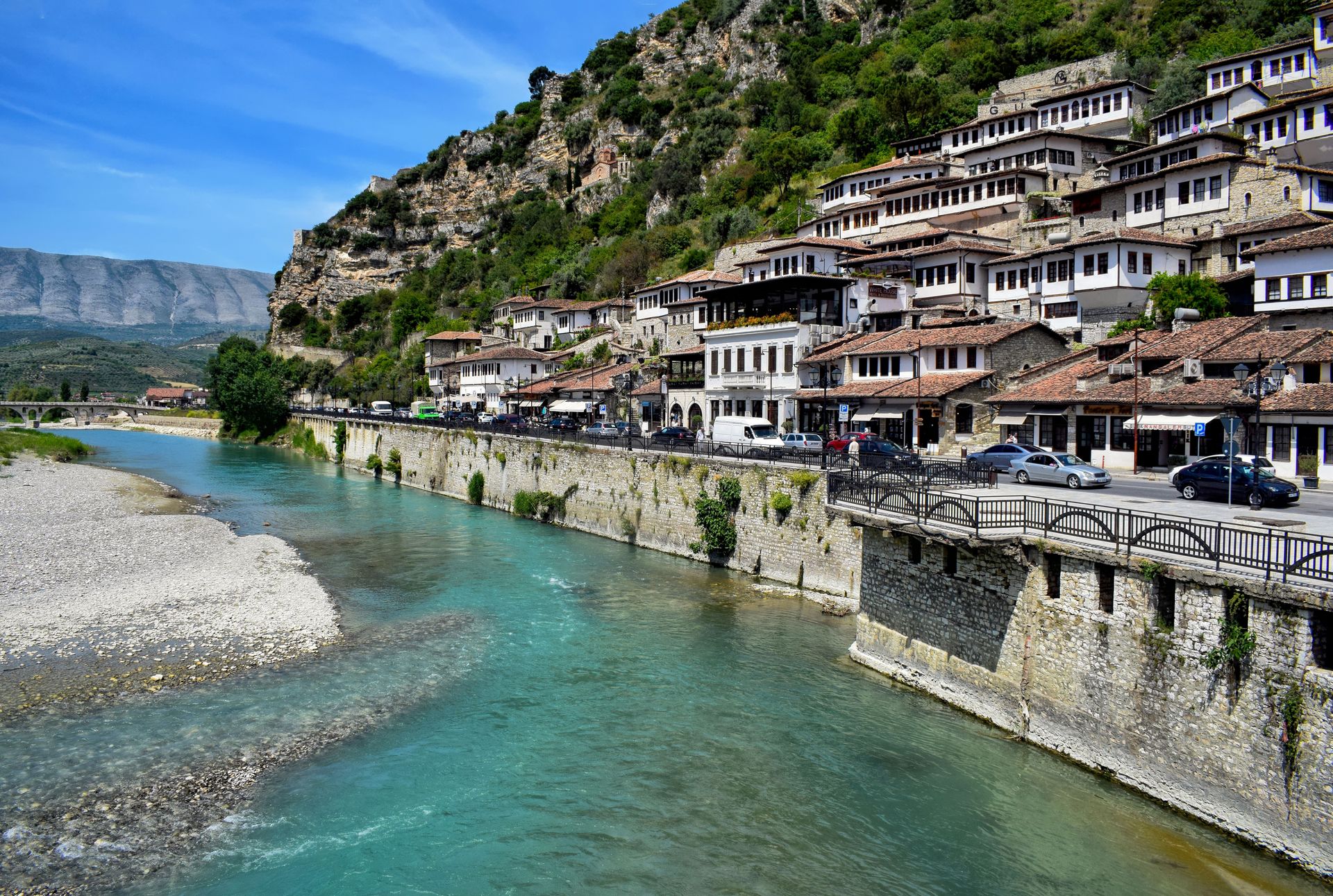
Its nickname, the "City of a Thousand Windows," made perfect sense when I saw the white Ottoman houses of Mangalem stacked tightly against the hillside, with row after row of windows facing the Osum River.
I loved exploring Mangalem on foot, but crossing the Gorica Bridge gave me an even better perspective as I looked back toward those famous houses.
Late afternoon was particularly beautiful, when the lowering sun caught the white facades and seemed to light up the entire hillside.
Berat Castle was another highlight. Unlike many castles I've visited, this one still feels like a neighborhood, with people living among its old houses, churches, walls, and narrow lanes.
I also stopped at the Onufri Museum to see its collection of religious icons and paintings.
Berat was also a great place to explore Albanian food. I'd recommend trying tavë kosi, one of the country's best-known traditional dishes.
It's essentially baked lamb and rice covered with a tangy mixture of yogurt and eggs, then cooked until the top becomes golden. It's rich, comforting, and exactly the sort of meal I wanted after spending the day walking Berat's steep streets.
Two nights gave me enough time to enjoy the city without rushing it.
How Berat fits into your Albania itinerary
Berat makes an easy stop south of Tirana and works particularly well before continuing toward Gjirokastër and the Albanian Riviera. Two nights also leave enough time to add a trip toward Osumi Canyon.
Stay until late afternoon rather than visiting Berat only as a day trip. Watching the sunlight hit Mangalem's white Ottoman houses was one of my favorite views in the city.
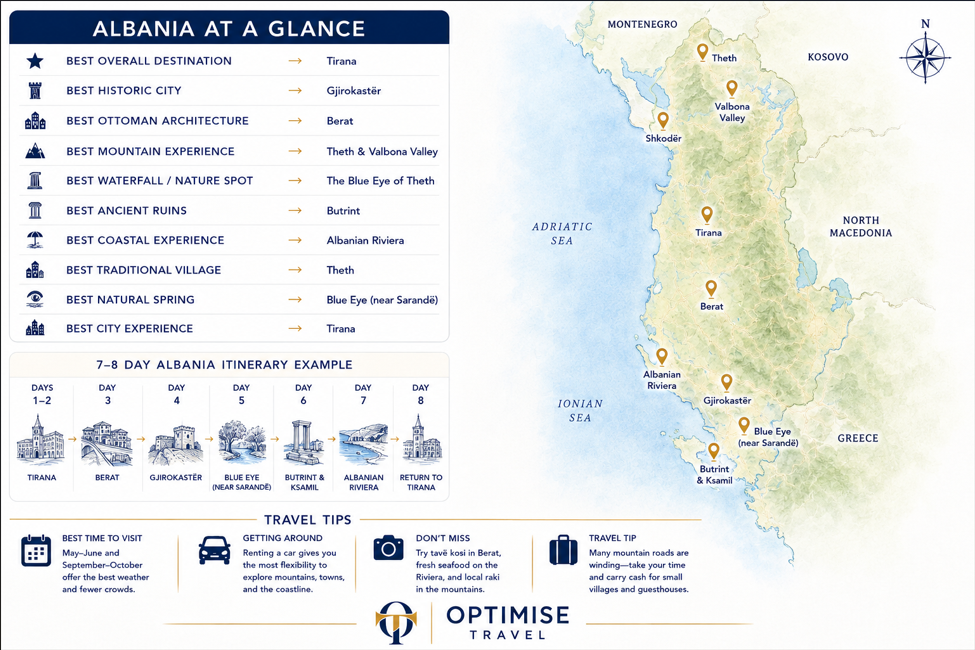
Albania may look relatively small on a map, but I wouldn't try to squeeze the entire country into one trip.
For a first visit, I think a 7–8 day Albania itinerary works best when you combine a little time in Tirana with the historic towns and beautiful coastline of southern Albania.
Albania Itinerary: 7–8 Days
Route: Tirana → Berat → Gjirokastër → Blue Eye → Sarandë → Butrint & Ksamil → Albanian Riviera → Tirana
| Days | Days | Days | Days | Days | Days | Days |
|---|---|---|---|---|---|---|---|
Destination | Tirana | Berat | Gjirokastër | Blue Eye & Sarandë | Butrint & Ksamil | Albanian Riviera & Dhërmi | Tirana |
Overnight | Tirana | Berat | Gjirokastër | Sarandë | Sarandë | Dhërm | Tirana or departure |
Why this route? For a first Albania itinerary, I think this gives you a fantastic introduction without spending the entire week in transit.
You'll experience Tirana's energy, the Ottoman architecture of Berat and Gjirokastër, the Blue Eye, ancient Butrint, and some of the country's best Ionian coastline.
*If you only have seven days, I'd spend one night rather than two in Tirana at the beginning and use your final day to return to the capital.
What about Shkodër, Valbona Valley, and Theth?
I'd save northern Albania for a second trip unless hiking is your main reason for visiting.
Valbona and Theth were home to some of my favorite hiking in Albania, but reaching them properly takes time, and I wouldn't sacrifice several days in the mountains just to squeeze them into an already busy one-week itinerary.
If hiking is your priority, I'd flip the plan entirely and build your week around Shkodër → Lake Koman → Valbona Valley → Valbona Pass → Theth, with Tirana at either end.
Why Albania deserves more attention when traveling the Balkans
Albania is one of those countries that I think is still far too easy to overlook when planning a trip through the Balkans.
Some of my favorite experiences were completely different from one another, from hiking through Valbona Valley and exploring the stone streets of Gjirokastër to taking a boat between hidden coves along the Riviera and wandering through the ancient ruins of Butrint.
I also loved how much variety Albania packed into one trip. I could explore Ottoman towns, hike through dramatic mountains, swim in ridiculously clear Ionian water, and experience energetic Tirana without ever leaving the country.
If you're already considering Greece, Montenegro, or the wider Balkans, I wouldn't treat Albania as somewhere to simply pass through. I'd give it at least a week and let it be a destination in its own right.
FAQs about traveling to Albania
The currency in Albania is the Albanian lek (ALL), although euros may also be accepted by some tourism businesses.
Travelers from the US, UK, Canada, Australia, and most European countries can visit Albania visa-free for short tourist stays, although the permitted length of stay depends on your nationality.
Driving in Albania is generally manageable, and traffic drives on the right-hand side of the road, but mountain roads, local driving habits, and road conditions can make some routes more challenging.
Albania is generally considered safe for travelers, although normal precautions against petty theft and other opportunistic crime are recommended.
Albania uses Type C and Type F plugs, with a standard voltage of 230V and frequency of 50Hz.
The official language of Albania is Albanian, although English is increasingly common in hotels, restaurants, and popular tourist destinations.
I'd recommend at least 7–8 days in Albania for a first trip, giving you enough time to combine Tirana, historic towns, and the Albanian Riviera without rushing between destinations.
Ready to explore Albania? Optimise Travel is here to help
Albania may be relatively compact, but deciding how to divide your time between its historic cities, Albanian Alps, ancient ruins, mountain villages, and beautiful Ionian coastline can still take some planning.
At Optimise Travel, we create personalized travel itineraries based on your interests, travel style, and budget.
Whether you're dreaming of hiking between Valbona and Theth, exploring Berat and Gjirokastër, discovering ancient Butrint, taking a boat between hidden coves along the Albanian Riviera, or experiencing the energy of Tirana, we'll help you build an itinerary that makes the most of your time.
If you'd like help planning your trip to Albania, click here to learn more about our concierge travel services.