

After years of planning trips for myself and countless others, the question I get most is some version of how far in advance to plan a trip.
Most people want a single number. What they actually need is the difference between starting to plan and starting to book, because those happen at two very different times.
Here’s the toolkit I use for planning a successful trip.
Quick-reference planning windows
Trip type | Recommended planning window |
|---|---|
Weekend getaway | 2 to 8 weeks |
Simple domestic vacation | 2 to 4 months |
Major domestic vacation | 3 to 6 months |
International vacation | 4 to 8 months |
Complex international itinerary | 6 to 12 months |
Family trip during school breaks | 6 to 12 months |
Peak-season or bucket-list trip | 6 to 12 months or more |
Large group or special-event trip | 6 to 12 months or more |
*These are planning guidelines, not guarantees of the lowest prices. The right timing depends on your flexibility, the season, availability, and complexity.
How far in advance should you start planning a trip?
Most leisure trips can begin around 3 to 6 months out. There's no single answer because the timeline depends on five things:
A flexible solo traveller on a short off-season flight can plan late and be fine.
A family of five flying long-haul over Christmas to one specific resort needs to start early, because the thing they want can simply run out. The more your trip leans toward the second, the earlier you begin.
Domestic trips
For most domestic trips, 2 to 4 months is plenty, and a simple weekend needs even less. What tightens the timeline isn't distance, it's demand. A national park in July or a beach town on a holiday weekend fills up the same way international trips do, and deserves the same earlier start.
International trips
For most international trips, 4 to 8 months works. Move toward 6 to 12 months when the trip involves several of these:
The reason isn't just airfare; it's availability. Visas take weeks, specific long-haul dates get limited, and small hotels run out quietly while you're still deciding.
Family and group trips
These deserve the earliest start of all, and coordination is the real challenge, not price. You're lining up school calendars, everyone's time off, room configurations, seats together, and attractions that sell out. Lock the dates first, and everything else has room to follow.
I've watched a trip nearly fall apart because two adults booked leave before checking the flights even existed on those dates.
Vacation planning timeline: what to do and when
Most articles blur the timeline for planning, researching, and booking. Here's how the stages separate, as a countdown.
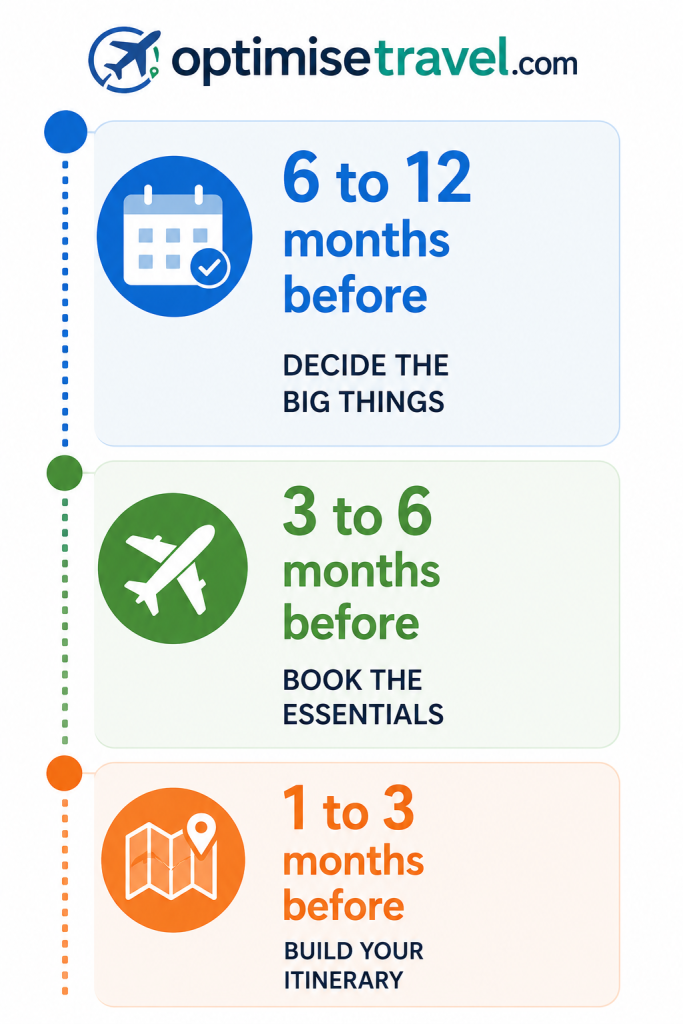
6 to 12 months before: decide the big things
This stage is decisions, not bookings:
3 to 6 months before: book the essentials
Now you start committing: book flights when price and dates line up, reserve the accommodation that matters most, arrange a rental car, and consider travel insurance.
One honest word on flights: there's no magic day when fares are always cheapest.
What works is monitoring prices over time, setting alerts, staying flexible on dates, comparing nearby airports, and comparing the total cost once bags and seats are added.
Start looking before you intend to buy, so you recognise a good fare when it appears.
1 to 3 months before: build your itinerary
With the big pieces set, fill in the trip: tours, attractions, train tickets, restaurant reservations, and transfers. The useful habit here is two lists:
Over-booking a trip is its own mistake. Leave room to actually be there.
2 to 4 weeks before: handle the details
These are admin weeks, and doing it now keeps the final days calm:
The final week
Keep it light. Check your flight status, confirm accommodation, look at the forecast, and pack.
Download tickets and documents so they work offline, and share your itinerary with someone at home if that suits your trip. Then stop planning and go.
How far in advance should you book flights and hotels?
When to book flights
Start looking earlier than you intend to buy. You're learning the price range so you can act when a good fare shows up. What actually helps:
What to ignore: any claim that one weekday is always cheapest. That myth has long since lost its usefulness.
When to book hotels
Hotel timing comes down to flexibility. If the hotel itself matters, book earlier. If you're flexible about where you stay, you can wait and compare.
Popular hotels, resorts, family rooms, and anything during a peak period deserve an early booking, because those rooms vanish first. Where you can, book refundable rates, which let you lock in the place you want now and keep comparing without risk.
When should you start planning even earlier?
Some trips move your whole timeline forward. Start earlier than usual when you're:
The pattern underneath all of these is the same. The less flexible your trip is, the earlier you should plan.
What if you're planning a last-minute trip?
Don't panic. Last-minute travel can work well if you're flexible, as long as you handle things in the right order:
Flexible destinations and dates make this far easier. And if it feels like too much on a short clock, this is exactly where a second set of experienced hands earns its keep.
The bottom line: earlier planning gives you more options
For most vacations, 3 to 6 months is practical. Complex international, peak-season, family, and bucket-list trips often benefit from 6 to 12 months. But the number was never really the point.
The takeaway worth keeping: start planning earlier than you start booking.
Planning early doesn't mean committing early. It means time to research, compare, and prioritise, so the trip you take is the one you actually wanted. The more fixed, complicated, or important your trip is, the more of that time you should give yourself.
Frequently asked questions
You should usually start planning a honeymoon 6 to 12 months in advance. Popular honeymoon destinations, specific resorts, long-haul flights, and fixed wedding dates can make early planning especially useful.
International visitors should generally start planning a trip to Europe 4 to 8 months in advance. Summer travel, popular destinations, multi-country itineraries, and trips with fixed dates may benefit from planning 6 to 12 months ahead.
You should generally start planning a trip to the US 4 to 8 months in advance. European travellers visiting during summer, major holidays, or popular events, or planning a multi-city road trip, may benefit from starting 6 to 12 months ahead to coordinate flights, accommodation, transport, and entry requirements.
You should usually start planning a large group trip 6 to 12 months in advance. Coordinating everyone's schedules, flights, accommodation, room requirements, and budget becomes more difficult as the group gets larger.
You should start planning Christmas and holiday travel 6 to 12 months in advance when possible. Flights, family-sized accommodation, resorts, and popular destinations can have limited availability during the busiest holiday periods.
Yes, you can start researching a trip before your travel dates are confirmed. You can compare destinations, estimate your budget, research entry requirements, and identify important accommodation or experiences without making non-refundable bookings.
Start planning your trip with us
Once you know your destination, dates, budget, and the kind of trip you want, the next step is turning that into a plan that holds together.
That's what we do at Optimise Travel. We help you build a practical, personalised plan, work out which reservations to make now and which to leave flexible, and catch the timing problems that quietly derail a trip. If the logistics are starting to feel bigger than the trip itself, let's get in touch.